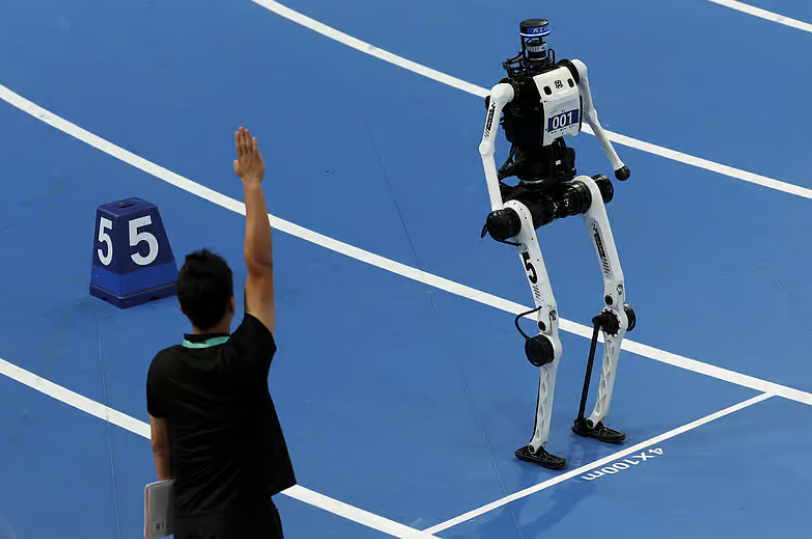
A Chinese humanoid robot has run 100 metres in 9.39 seconds at the World Humanoid Robot Games in Beijing, producing a time faster than the human world record set by Jamaican sprinting legend Usain Bolt.
Tiangong Ultra, developed by the Beijing Humanoid Robot Innovation Center, won its preliminary heat on Saturday during the second edition of the competition. Organisers said the performance represented a major improvement from last year, when the robot completed the same distance in 21.50 seconds.
The latest result was achieved during the opening day of the games, which feature 51 events covering athletics, football, dancing and industrial tasks.
Another Chinese humanoid robot, Lightning, also attracted attention before the competition. State media reported that it completed 100 metres in 9.32 seconds during a preparatory test, reaching a top speed of 14.5 metres per second.
Lightning had already demonstrated its capabilities by winning this year’s humanoid half-marathon in Beijing in 50 minutes and 26 seconds. That performance was faster than the pace associated with the elite men’s human world record over the distance.
The robot stands 169 centimetres tall and originally had legs measuring 95 centimetres. Researchers later extended its legs to 1.05 metres ahead of the games, according to Chinese broadcaster CCTV.
Tiangong Ultra also won the world’s first humanoid robot half-marathon, held in Beijing last year, as Chinese developers continue to improve robots’ ability to walk and run at higher speeds.
The performances highlight the rapid progress being made in China’s humanoid robotics sector. However, comparisons with human athletic records are not directly equivalent because robots operate under different physical conditions and competition rules.
China has identified humanoid robots as a strategic emerging industry, with government policymakers and technology companies investing heavily in artificial intelligence, robotics hardware and manufacturing capabilities.
Developers are targeting applications in factories, logistics, services and potentially household environments. Improvements in balance, movement, battery performance and artificial intelligence are expected to influence how quickly the technology can move into practical use.
Investor interest has also grown rapidly. Shares in Unitree, one of China’s best-known humanoid robot manufacturers, surged more than fivefold during its Shanghai trading debut earlier this week, giving the company a reported market value of around $50 billion.
This year’s World Humanoid Robot Games have attracted 2,056 robots representing 666 teams from 16 countries across six continents. That compares with 280 teams at the inaugural competition.
The games are being held at Beijing’s National Speed Skating Oval and will continue through Wednesday, giving researchers and companies several more opportunities to demonstrate advances in humanoid robotics.