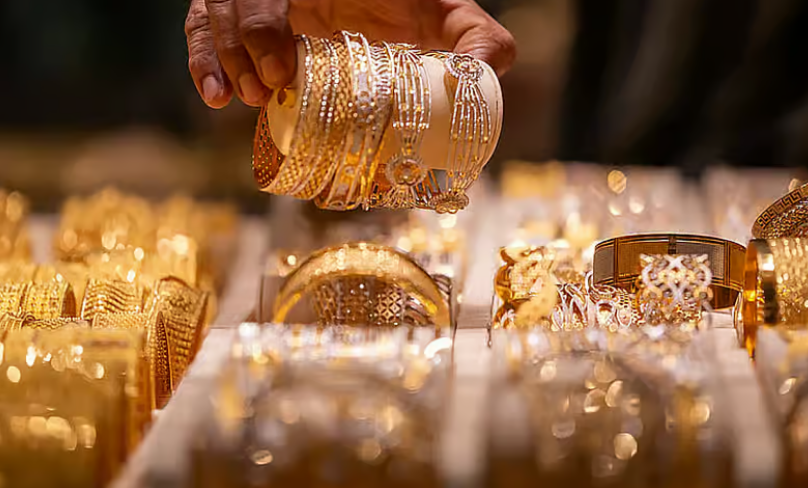
Gold prices in the UAE remained largely stable on Monday morning, with only a marginal decline recorded as a ceasefire between the United States and Iran continued to hold, easing immediate market volatility.
The price of 24-karat gold slipped slightly by Dh1 per gram to Dh555, compared to Dh556 at the end of last week. Other variants showed similar stability, with 22K gold priced at Dh513.75 per gram, 21K at Dh492.75, 18K at Dh422.25, and 14K at Dh329.50 per gram.
On the global market, spot gold was trading at $4,610.75 per ounce, down 0.4 per cent during early trading hours in the UAE. Silver prices also edged lower, falling 0.6 per cent to $75.2 per ounce.
Market analysts say the relative calm follows recent fluctuations driven by geopolitical developments. Vijay Valecha, Chief Investment Officer at Century Financial, noted that gold had rebounded in the previous session as oil prices eased due to profit-taking and the US dollar weakened.
He added that currency movements were influenced by expectations of possible intervention by Japan in foreign exchange markets, which contributed to the dollar’s decline and supported bullion prices.
Despite the short-term stability, analysts caution that gold continues to face pressure from broader economic factors. Ongoing tensions in the Middle East and disruptions linked to the Strait of Hormuz have triggered an energy supply shock, raising concerns about inflation.
Higher inflation expectations often lead central banks to maintain or increase interest rates, which can weigh on gold since it does not offer yields like interest-bearing assets. Valecha said this dynamic could limit further gains in the near term, even as safe-haven demand remains present.
He also pointed to recent market behaviour earlier in the year, when a correction in global equity markets led to increased selling pressure on gold, highlighting the metal’s sensitivity to broader financial conditions.
Looking ahead, analysts maintain that the long-term outlook for gold remains supported by structural factors, particularly continued purchases by central banks seeking to diversify reserves.
While prices have stabilised for now, traders are expected to remain cautious as geopolitical developments and monetary policy signals continue to shape the direction of precious metals in global markets.