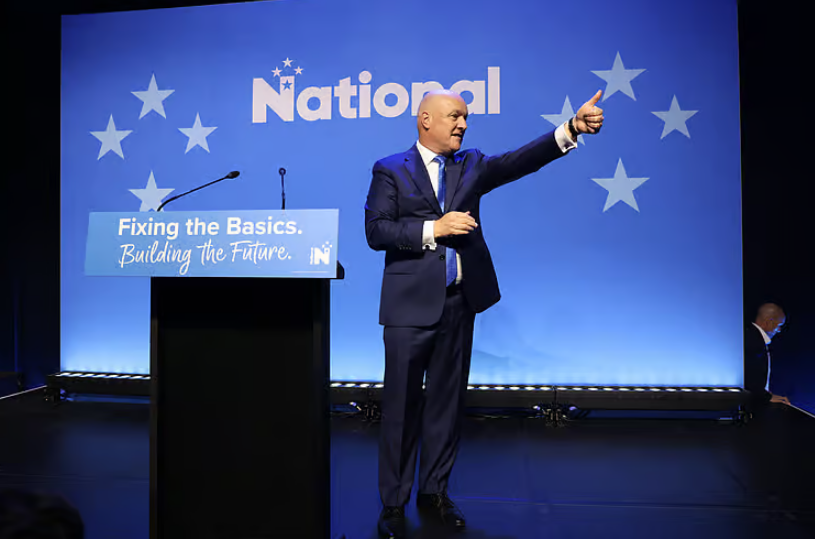
New Zealand Prime Minister Christopher Luxon said his National Party had a route to forming the next government after a closely contested general election, but acknowledged that the final outcome remained uncertain and negotiations with smaller parties would be necessary.
Preliminary results placed National slightly ahead of the centre-left Labour Party, with both securing around 29% of the party vote. The narrow gap left neither major party with enough seats to govern independently.
National was projected to win the largest number of seats, potentially giving the right-wing coalition a two-seat majority when combined with its partners, the populist New Zealand First and libertarian ACT.
Speaking to supporters in Auckland, Luxon said National had a pathway to forming the next government but warned that the result was too close to call.
He said his administration would continue as a caretaker government until the final votes were counted on November 27. The remaining special votes, which include ballots cast by New Zealanders living overseas, could change the balance of parliament.
Luxon said meaningful negotiations would begin once the final results were confirmed.
Labour leader Chris Hipkins also acknowledged the uncertainty, telling supporters in Upper Hutt, near Wellington, that the country had delivered a message that could take time to interpret.
He said the next parliament would require compromise and cooperation, adding that Labour would work to form a government if given the opportunity. Otherwise, the party would continue representing its supporters in parliament.
Minor parties hold key to government formation
The close result has increased the importance of smaller parties, particularly the centrist Opportunity Party, which appeared to have secured more than the 5% threshold required to enter parliament without winning an electorate seat.
New Zealand uses a mixed-member proportional representation system, under which voters cast separate ballots for a political party and a local parliamentary candidate.
Opportunity Party leader Qiulae Wong said voters had chosen unity over division and pledged to pursue a more cooperative approach to politics. She said she was prepared to work with whichever party secured the strongest result and had already been in contact with both major party leaders.
Cost of living dominates campaign
The election campaign was largely shaped by economic concerns, with households struggling against persistently high prices for essential goods and unemployment reaching its highest level in more than a decade.
The economic impact of the Middle East war and the resulting global fuel shock also contributed to public frustration.
Luxon had campaigned on a promise of no new taxes after three years of coalition government marked by internal tensions and two unsuccessful attempts by members of his own party to replace him as leader.
Even if National returns to power, the party will face a changed parliamentary team. Finance Minister and deputy leader Nicola Willis is set to leave parliament following National’s weak party vote performance. Housing, Infrastructure and Transport Minister Chris Bishop also appeared at risk of losing his Hutt South seat.
The final count will determine whether Luxon’s coalition can retain office or whether smaller parties will help Labour assemble an alternative government.