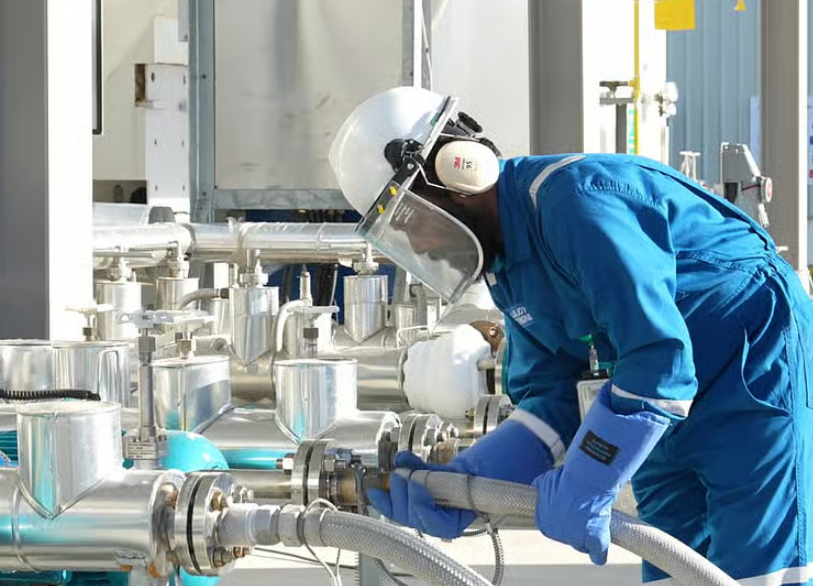
Demand for carbon dioxide is expected to increase across the Gulf as population growth, industrial expansion, food security needs and reliance on desalinated water drive consumption, according to the chief executive of the region’s largest liquid carbon dioxide supplier.
Ranjith Nair, CEO of Gulf Cryo, said the global carbon dioxide market was valued at $11.9 billion in 2025. The Middle East market is forecast to expand at an annual rate of 5.6 per cent to reach $2.29 billion by 2034, according to Polaris. Food and beverage applications account for about 41 per cent of regional demand.
Nair said carbon dioxide is widely used in food and beverage production, water treatment, healthcare and industrial processes. Population growth is increasing demand for carbonated drinks and bottled water, while industrial activity is creating additional requirements for applications such as welding.
Food security is another major factor. Around 80 per cent of the region’s food is imported, while greenhouses use carbon dioxide to improve plant growth. Hospitals also rely on the gas for medical applications.
Water security is adding to demand. About 80 per cent of drinking water in the UAE comes from desalination, while the Gulf Cooperation Council accounts for roughly one-third of global desalination capacity. Nair said carbon dioxide is required in the desalination process.
The energy sector also uses carbon dioxide in enhanced oil recovery, where the gas is injected into mature oil fields to improve production. Gulf Cryo supplies carbon dioxide captured from refineries for such operations.
Nair said efforts to reduce industrial emissions could create additional demand as newer facilities capture and process carbon dioxide rather than release it.
Gulf Cryo is expanding production capacity to meet expected growth. Regional capacity currently stands at 695 metric tonnes per day and is scheduled to reach 1,300 MTPD by the end of 2026, equivalent to more than 470,000 tonnes annually.
By year-end, capacity is expected to reach 200 MTPD in the UAE, 750 MTPD in Saudi Arabia and 350 MTPD in Kuwait. The facilities also supply other GCC markets.
The company has additional capacity that can be activated during plant maintenance, seasonal demand peaks or supply disruptions. This could take total available capacity above 2,000 MTPD, or about 750,000 tonnes annually.
The biggest expansion is taking place in the UAE, where capacity will quadruple to 200 MTPD. A second carbon capture facility in Abu Dhabi is due to begin operations by the end of 2026 and is expected to reduce the country’s reliance on imports from neighbouring Gulf markets.
The project comes as the UAE advances its carbon capture strategy after issuing its national Carbon Capture Policy in January. ADNOC has set a target of capturing 10 million tonnes of carbon dioxide annually by 2030.
Gulf Cryo has carbon recovery agreements with industrial companies including RAK Ceramics, Equate, Petro Rabigh and Ma’aden. The company introduced carbon capture technology to the region in 2014 at Equate, where annual production has since risen to 127,750 tonnes from 54,750 tonnes.
More than 98 per cent of carbon capture projects in the Middle East and North Africa are located in the GCC, while Saudi Arabia is targeting 44 million tonnes of annual capture capacity by 2035.