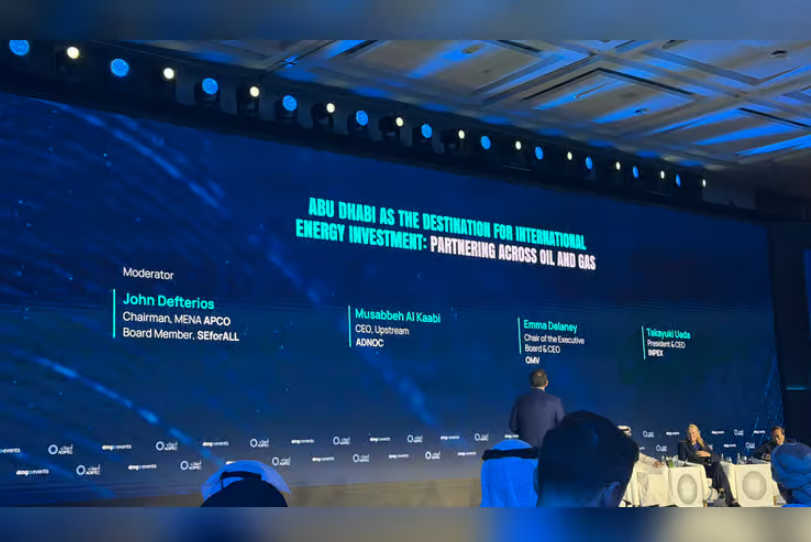
Energy companies must strengthen their ability to withstand market disruptions and maintain reliable supplies, Musabbeh Al Kaabi, ADNOC’s chief executive for upstream, said at Adipec 2026, highlighting the need for long-term partnerships, diversified transport routes and continued investment.
Speaking during a panel discussion titled “Abu Dhabi as the Destination for International Energy Investment: Partnering Across Oil and Gas”, Al Kaabi said companies needed to prepare for unexpected events rather than concentrate exclusively on operational efficiency and maximising the use of their assets.
He said ADNOC had drawn important lessons from the disruptions facing the energy sector this year, particularly the importance of protecting employees, maintaining customer relationships and ensuring operations could continue under difficult conditions.
Employee safety and the security of operational sites remained the company’s highest priorities during the recent challenges, Al Kaabi said. Long-term infrastructure investment and international partnerships had also helped ADNOC respond to changing market conditions.
He added that the company had worked closely with customers and partners across different markets to preserve commercial relationships and address supply challenges. ADNOC continued to invest in resource development despite the uncertainty, reflecting its confidence in future global energy demand.
The panel also featured Emma Delaney, chair of the executive board and chief executive of OMV, and Takayuki Ueda, president and chief executive of INPEX. It was moderated by John Defterios, chairman of MENA APco and a board member of SEforALL.
Delaney said successful partnerships depended on shared objectives, trust and cooperation during periods of uncertainty. She stressed the importance of emergency preparedness, business continuity planning and alternative operating arrangements when established supply systems face disruption.
She said partnerships should deliver benefits beyond financial investment, including access to technology, specialised products, operational expertise and international markets. Sharing knowledge and technical capabilities between companies could help strengthen resilience, she added.
Ueda said recent disruptions had reinforced the need for countries heavily dependent on imported energy to diversify their supply routes. However, he stressed that diversification did not mean moving away from established suppliers such as the UAE.
Japan’s longstanding energy relationship with the UAE provided a foundation for further cooperation, he said, adding that trust, cultural understanding and personal relationships remained important to international business.
Defterios also highlighted the rising cost of transporting energy following regional disruptions. He referred to remarks by Dr Sultan Ahmed Al Jaber, UAE Minister of Industry and Advanced Technology and ADNOC’s managing director and group chief executive, that shipping and logistics costs had increased from less than 5 per cent to more than 30 per cent of the cost of a barrel.
Al Kaabi also pointed to artificial intelligence as an increasingly important tool for the energy industry, particularly in subsurface analysis, well management, production operations and industrial processes.
The comments followed ADNOC’s announcement of a partnership with OpenAI and G42 to expand the use of advanced AI across its operations. Executives said combining technology, investment and operational expertise would be essential as the industry prepares for future demand and changing market conditions.