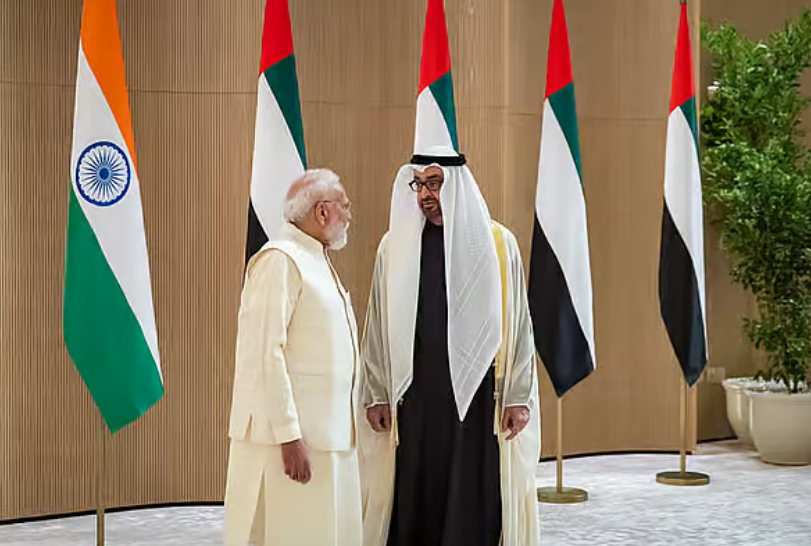
Indian Prime Minister Narendra Modi’s latest visit to the UAE has marked another major step in the growing partnership between the two countries, with both sides announcing agreements spanning energy, defence, artificial intelligence, infrastructure and maritime cooperation.
The visit comes as India and the UAE push to expand bilateral trade to $200 billion over the next decade after already crossing the $100 billion milestone ahead of schedule. Analysts say the relationship is rapidly evolving from a traditional oil-and-trade partnership into a broader strategic alliance centred on investment, technology and regional security.
Energy security emerged as a central focus during the visit as global markets remain unsettled by tensions linked to the US-Iran conflict and instability around the Strait of Hormuz. India imports nearly 90 per cent of its crude oil needs, making reliable suppliers increasingly important for the country’s economy.
One of the key agreements signed involved collaboration between Indian Strategic Petroleum Reserves Limited and Abu Dhabi National Oil Company to expand the UAE’s role in India’s strategic petroleum reserves. The arrangement includes existing ADNOC storage facilities at Mangaluru and potential future storage projects at Visakhapatnam and Chandikol in Odisha.
The agreement also opens the possibility of India storing crude oil in Fujairah while both countries explore cooperation in liquefied natural gas and liquefied petroleum gas storage projects.
India currently holds around 5.33 million metric tonnes of strategic crude reserves, equal to about 38 million barrels, stored in underground facilities across the country. Expanded UAE participation is expected to strengthen India’s protection against future supply disruptions and oil price shocks.
The UAE already supplies around 11 per cent of India’s crude imports and nearly 40 per cent of its LPG requirements, making it one of New Delhi’s most important energy partners.
Sultan Ahmed Al Jaber, managing director and group chief executive of ADNOC, described India as “one of the defining energy markets of our time,” pointing to rising demand driven by population growth and economic expansion.
The visit also produced agreements covering defence manufacturing, cyber security and maritime infrastructure. India and the UAE signed a framework for a strategic defence partnership aimed at boosting military training cooperation, secure communications and defence innovation.
A separate agreement between Cochin Shipyard and Drydocks World will establish a ship repair and maritime infrastructure cluster at Vadinar in Gujarat, supporting India’s ambitions to become a regional maritime hub.
In the technology sector, UAE-based G42 and India’s Centre for Development of Advanced Computing agreed to establish major AI supercomputing infrastructure in India.
The UAE also announced investments worth $5 billion in India, including banking and infrastructure commitments involving Emirates NBD, Abu Dhabi Investment Authority and International Holding Company.
Business leaders said the agreements reflect the continued expansion of the Comprehensive Economic Partnership Agreement signed in 2022, which sharply accelerated trade and investment flows between the two countries.
Analysts now view the India-UAE partnership as an increasingly influential economic corridor linking South Asia, the Gulf and Africa through energy trade, logistics, technology and long-term investment cooperation.