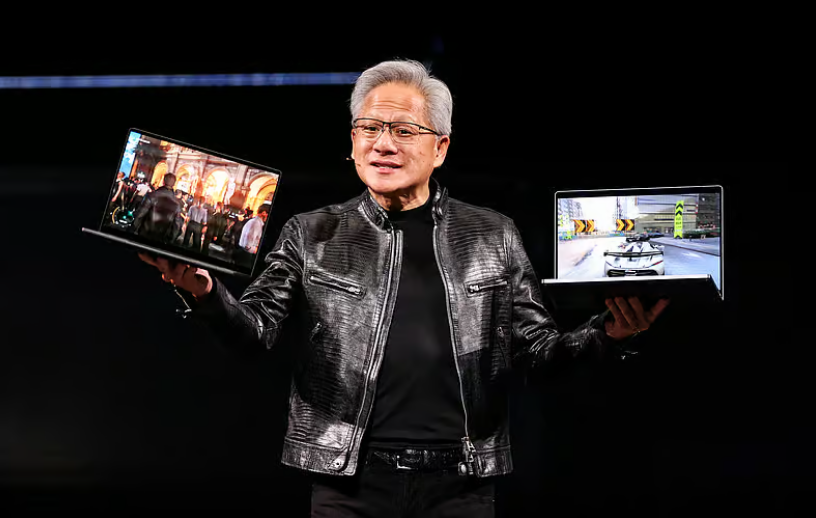
Nvidia unveiled a new laptop chip for Windows computers on Monday, making a bold entry into the rapidly evolving market for artificial intelligence-powered personal computers and setting up fresh competition with established players including Apple, Intel and AMD.
The announcement came ahead of Computex, one of the technology industry’s largest annual exhibitions, where Nvidia chief executive Jensen Huang introduced the company’s new RTX Spark platform. The launch marks a notable expansion for Nvidia, whose soaring value has been fuelled largely by demand for data centre processors powering artificial intelligence systems worldwide.
Speaking at the unveiling, Huang described the new generation of AI-integrated computers as a major shift in personal computing.
“Microsoft and Nvidia are going to reinvent the PC. This is going to be the new PC,” Huang said, highlighting the device’s ability to support a wide range of scientific and computational workloads.
Nvidia has built its global reputation through graphics processing units, or GPUs, which were initially developed for video gaming but later became central to AI technologies ranging from chatbots and image generators to software agents capable of completing user tasks.
The company’s latest move, however, centres on the central processing unit, or CPU, the component traditionally considered the brain of a computer. By entering this segment more aggressively, Nvidia is seeking a broader role in consumer computing at a time when AI is reshaping how devices are designed and used.
Analysts say the development could alter the competitive landscape in the PC industry.
Stephen Wu, a former AI software engineer and founder of investment firm Carthage Capital, described Nvidia’s strategy as a significant challenge to conventional chipmakers.
According to Wu, the company is attempting to create a tightly integrated hardware ecosystem that could influence how developers build future software and AI tools.
He argued that the move poses a direct threat to Intel and AMD, particularly as AI users increasingly demand greater processing power and memory capacity to run advanced models locally with minimal delay.
While Nvidia previously supplied chips for Windows tablets during the early 2010s, the new platform is aimed at a different market. Rather than focusing primarily on entertainment or productivity, the devices are designed to run AI-based applications and digital assistants capable of carrying out increasingly complex tasks.
Industry observers expect the first wave of devices using the technology to carry premium prices, reflecting both their advanced hardware and their positioning as next-generation computing tools.
Nvidia’s expansion into consumer devices comes as governments and technology companies continue investing heavily in AI infrastructure. The company has become one of the world’s most valuable firms as demand for its chips surges across cloud computing and large-scale AI development.
Huang compared the current transition to the transformation brought by smartphones, calling the redesign of the personal computer one of the industry’s biggest shifts in decades.