China is placing digital and intelligent transformation at the centre of its economic development strategy as it seeks to strengthen industries, improve productivity and accelerate the use of advanced technologies.
The concept features prominently in the country’s 15th Five-Year Plan for National Economic and Social Development, covering the period from 2026 to 2030. The change in terminology from “digitalisation” in the previous five-year plan reflects China’s growing focus on artificial intelligence and intelligent technologies.
The approach combines digital systems with technologies capable of analysing information, making decisions, identifying patterns and responding to complex situations. Officials and industry leaders see the shift as an important step towards higher-quality economic growth.
China has made significant progress in building the infrastructure needed for this transition. Its core artificial intelligence industry exceeded 1.2 trillion yuan ($176.52 billion) in 2025. By the end of March 2026, the country had built 4.958 million 5G base stations.
The eight national computing hubs developed under the “East Data, West Computing” initiative have also grown into major computing clusters. China’s overall computing capacity now ranks second globally, providing a stronger technological foundation for businesses and researchers.
The transformation is already changing industrial operations. Guangxi Liugong Machinery Co Ltd, for example, has developed a smart mining system that allows unmanned excavators to carry out precision work while autonomous trucks plan their routes.
Mining has traditionally depended heavily on human labour and exposed workers to considerable safety risks. Automated systems can reduce those risks while improving accuracy and operational efficiency.
Similar developments are taking place across manufacturing and other industries, where companies are building smart workshops, intelligent factories and automated equipment.
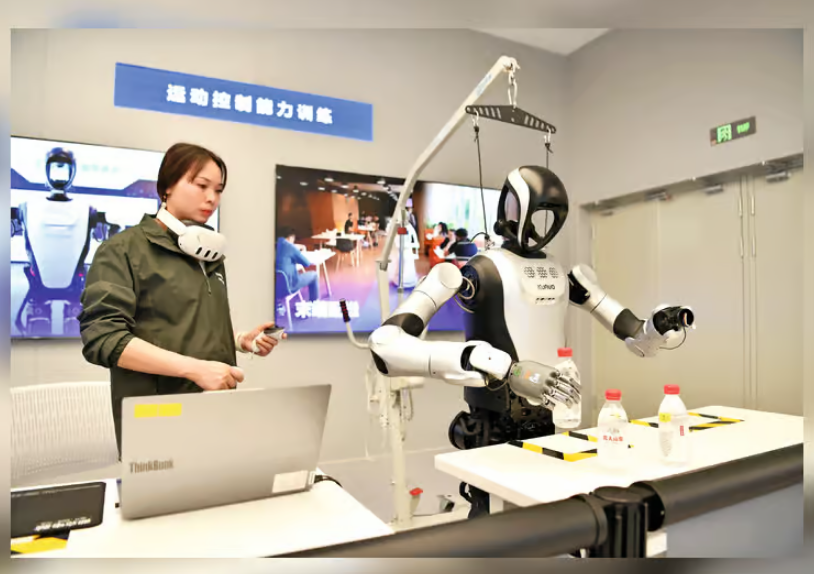
The robotics sector is another area benefiting from the trend. Researchers at Hunan University have developed a bionic dual-arm robot capable of handling glass bottles and placing them on pharmaceutical spectrometers for testing.
Zhang Hui, dean of the university’s School of Artificial Intelligence and Robotics, said researchers had created a “physical feedback learning” mechanism that allows the robot to improve through repeated practice.
Demand for intelligent machines is creating opportunities across related industries, including sensors, decision-making technologies, execution systems and system integration.
China has also demonstrated the potential of intelligent technology in transport. At the end of 2025, the country successfully tested a 35,000-tonne heavy-haul train convoy involving seven 5,000-tonne freight trains. Instead of traditional mechanical coupling, the trains coordinated acceleration and braking through an intelligent control system.
Under the 15th Five-Year Plan, China aims to strengthen computing infrastructure, algorithms and high-quality data resources. It also plans to expand its “AI Plus” initiative across industry, science, public services, culture and social governance.
At the same time, authorities intend to strengthen data rules and artificial intelligence governance. The goal is to create a secure and fair environment while using emerging technologies to improve productivity and support more efficient economic and social development.