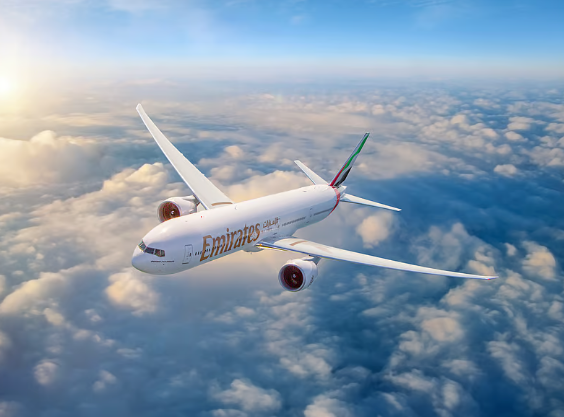
An Emirates flight from Dubai to Newcastle was forced to declare a mid-air emergency on January 27, leading to its diversion to Edinburgh Airport due to extreme weather conditions.
Flight EK035 departed Dubai at 13:53 local time and was scheduled to arrive in Newcastle at 11:20 am local time. However, as the Boeing 777 approached Northern England, it encountered the full impact of Storm Chandra, facing heavy rain, thick mist, and crosswinds reaching up to 60 mph. The challenging conditions made the final approach to Newcastle Airport difficult, prompting the crew to prioritise passenger safety.
According to Emirates, “Adverse weather on January 27 led to the diversion of Flight EK035 from Dubai to Newcastle, which was rerouted to Edinburgh. The safety of our passengers and crew is of utmost importance and will not be compromised.”
Flight tracking data from Flightradar24 revealed that the aircraft circled above Newcastle and Sunderland while the pilots attempted to stabilise the approach. EK035 executed two go-arounds, a manoeuvre in which the aircraft aborts a landing attempt, circles back, and makes another approach. When it became clear that landing safely at Newcastle was not possible, the pilot activated an emergency protocol known as “squawking 7700,” signaling a general emergency to air traffic control.
In aviation, “squawk 7700” is a code used to communicate that an aircraft is in serious trouble. Aircraft are equipped with a transponder, a device that sends information to air traffic control radar. By setting the transponder to 7700, pilots alert all nearby controllers and emergency teams on the ground, ensuring that the plane receives priority handling and immediate support if necessary.
The Boeing 777 landed safely at Edinburgh Airport, avoiding any injuries or damage. Emirates apologised for the inconvenience caused to passengers and thanked them for their patience as crews managed the emergency with precision.
Flight EK035’s diversion highlights the ongoing challenges posed by Storm Chandra, which has brought severe weather to parts of Northern England, including strong winds and heavy rainfall, disrupting flights and ground travel. Aviation experts noted that the successful handling of the situation reflected both rigorous pilot training and the robust safety protocols employed by airlines to respond to extreme weather events.
Passengers on board were able to continue their journey after the aircraft landed safely in Edinburgh. Emirates said arrangements were made to transport travellers to Newcastle once conditions allowed, emphasising that safety would remain the airline’s top priority.