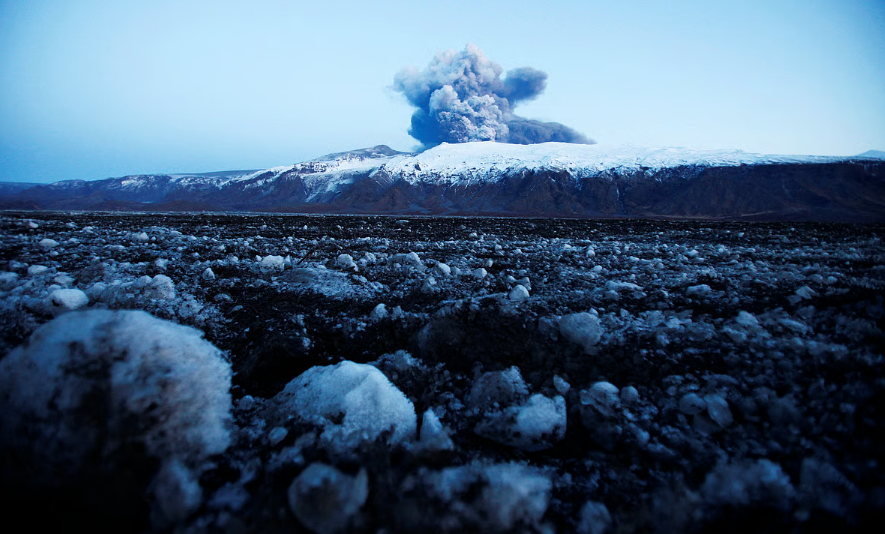
Air travel across parts of Asia and the Middle East has faced fresh disruption after the Hayli Gubbi volcano in northeastern Ethiopia erupted for the first time in nearly 12,000 years. The rare event sent dense plumes of ash and smoke as high as 14 kilometres into the atmosphere on Sunday, with winds pushing the cloud eastward over the Red Sea and towards the Middle East, Pakistan and India.
The eruption lasted for several hours, triggering warnings for aviation authorities across multiple regions. Ash clouds at high altitudes can damage aircraft engines, forcing airlines to alter routes or cancel operations altogether. Several high-altitude flight paths between India and Gulf countries have been temporarily affected.
Air India and IndiGo were among the first to cancel services, saying checks were necessary for aircraft that had already flown through the affected air corridors. The carriers stressed that safety assessments were underway as they monitored the movement of volcanic ash through international aviation tracking systems.
In contrast, Dubai-based airlines reported no disruption. Emirates and flydubai confirmed that flights, including those operating to Ethiopia’s capital Addis Ababa, departed as scheduled. Data from Dubai Airports showed services to and from Dubai International Airport running on time, with later departures also proceeding normally.
Volcanic events have caused major global aviation shutdowns in the past. The current disruption has revived comparisons with several large-scale eruptions that historically grounded flights and stranded passengers worldwide.
One of the most significant examples is the Eyjafjallajökull eruption in Iceland in April 2010. The volcano erupted for 39 days, releasing a massive ash cloud that drifted across Europe and resulted in the closure of over 300 airports. More than 100,000 flights were cancelled, affecting around 10 million passengers. On the first day alone, 8,200 flights were grounded and industry losses climbed to an estimated £1.1 billion.
In June 2011, Chile’s Puyehue-Cordón Caulle volcano erupted after more than five decades of dormancy. The ash cloud spread as far as Australia, disrupting hundreds of flights and impacting more than 120,000 passengers across South America and the Pacific.
The Philippines experienced similar upheaval in January 2020 when Taal volcano, located 70km from Manila’s main airport, erupted. A total of 604 flights were cancelled as ash and gases drifted across nearby airspace.
Iceland’s Grímsvötn volcano also caused widespread disruption in May 2011. Around 500 flights were cancelled over three days as the ash cloud moved over parts of Northern Ireland, Scotland and Scandinavia.
In November 2017, Bali’s Mount Agung erupted, forcing the cancellation of 445 flights and affecting nearly 59,000 passengers as ash towers reached 6,000 metres.
Aviation authorities across affected regions continue to monitor the Hayli Gubbi ash plume, with meteorological agencies tracking its movement to assess potential risk to aircraft operating at cruising altitude.