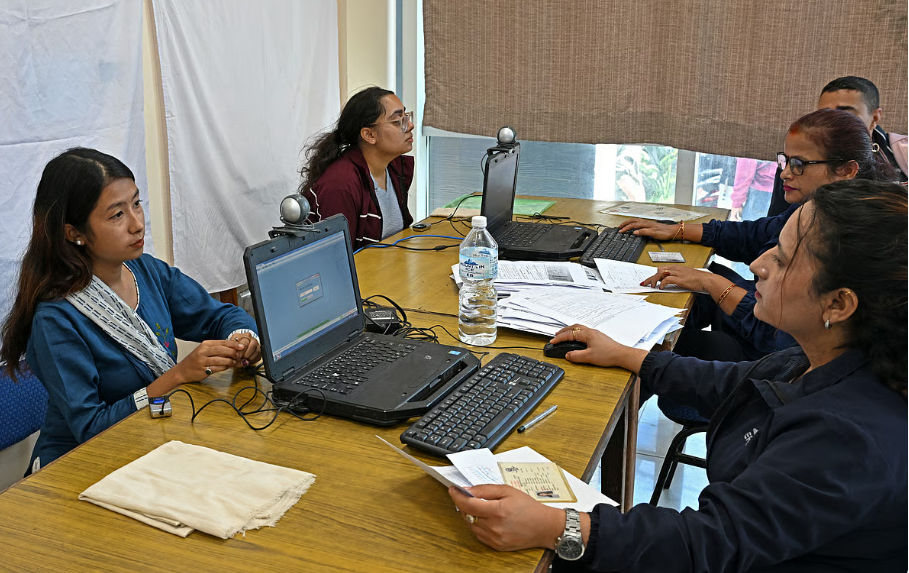
Nepal’s Election Commission announced on Wednesday that 125 political parties have registered to take part in the country’s first parliamentary elections since the mass uprising in September that toppled the government.
The March 2026 vote will mark a key test for Nepal’s fragile democracy after weeks of violent unrest earlier this year left deep political and social scars. While many of the registered parties are long-established groups, several new entrants have emerged from the youth-led anti-corruption movement that mobilized thousands during the September protests.
“We are working with the belief that all political parties and citizens are eager to bring a new leadership to the country through the election,” commission spokesman Narayan Prasad Bhattarai told AFP. He said registration will remain open for another two weeks, with the final list of parties, including those formed by youth activists, to be published after the November 18 deadline.
The protests that erupted in September began after a temporary ban on social media but quickly evolved into a national outcry against corruption, unemployment, and economic inequality. Within days, the demonstrations escalated into widespread violence, leaving at least 73 people dead and several government buildings, including parliament and the courts, set ablaze.
In the aftermath of the unrest, former chief justice Sushila Karki, 73, was appointed interim prime minister to oversee the transition and prepare for elections. Her administration has promised to restore stability and rebuild public confidence in democratic institutions.
Despite those pledges, uncertainty continues to cloud Nepal’s political future. Many citizens have lost faith in traditional parties accused of mismanagement and corruption, while the growing influence of youth movements presents both an opportunity and a challenge for the political establishment.
Bhattarai said the commission is committed to ensuring that the election will be “peaceful, impartial, and fear-free.”
Prime Minister Karki has also begun outreach efforts aimed at bridging divisions. On October 29, she convened the first round of talks between major political parties and youth representatives since the protests. The meeting included members of the ousted premier KP Sharma Oli’s party, signaling an attempt to foster dialogue among all factions.
The September turmoil dealt another blow to Nepal’s already struggling economy. The World Bank warned last month that political instability and weak consumer confidence could slow growth to 2.1 percent this year. It also noted that around 82 percent of Nepal’s workforce remains in informal employment, with GDP per capita estimated at $1,447 in 2024.
With just months left before the March 2026 elections, the country faces a delicate balancing act — restoring stability while responding to public demands for reform and accountability.