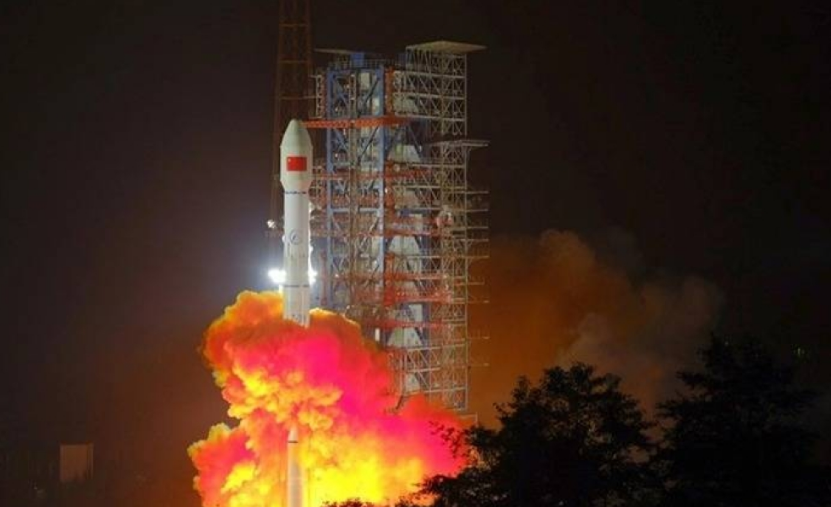
China successfully launched a new Earth observation satellite on Sunday, marking another milestone in the country’s rapidly expanding space programme. The Gaofen-14-02 satellite lifted off from the Xichang Satellite Launch Center in Sichuan Province aboard a Long March-3B carrier rocket and entered its planned orbit shortly after launch, according to state media.
Developed as part of China’s high-definition Earth observation project, the Gaofen-14-02 satellite is designed to capture high-precision, three-dimensional images of the planet’s surface. Officials said the satellite will play a key role in gathering global geographic data and providing crucial support for national economic planning, resource management, and defence-related applications.
The Gaofen series—whose name means “high resolution” in Chinese—was initiated in 2010 with the goal of building a comprehensive, high-definition Earth observation system by combining optical, radar, and infrared imaging satellites. The new Gaofen-14-02 represents one of the most advanced in the series, equipped with upgraded imaging systems capable of producing detailed stereo maps with greater efficiency and accuracy.
Experts say the satellite’s imagery will aid in various civilian and scientific endeavours, including environmental monitoring, land surveying, urban planning, and disaster prevention. At the same time, its high-resolution data will enhance China’s ability to support national defence and infrastructure development projects.
The Long March-3B rocket used for Sunday’s mission is one of China’s most reliable and frequently used launch vehicles. It has been the workhorse for many of the country’s major space missions, including launches to geostationary orbit and interplanetary probes. The successful flight marked the 603rd mission of the Long March rocket family, underscoring the maturity and consistency of China’s launch technology.
China has significantly accelerated its space activities in recent years, with an ambitious schedule that includes lunar exploration, Mars research, and the completion of its own space station, Tiangong. The latest launch adds to a growing list of satellite deployments aimed at strengthening China’s Earth observation network and advancing its strategic capabilities in space.
With the Gaofen-14-02 now in orbit, China continues to bolster both its scientific and technological footprint beyond Earth, reinforcing its position as one of the world’s leading spacefaring nations.