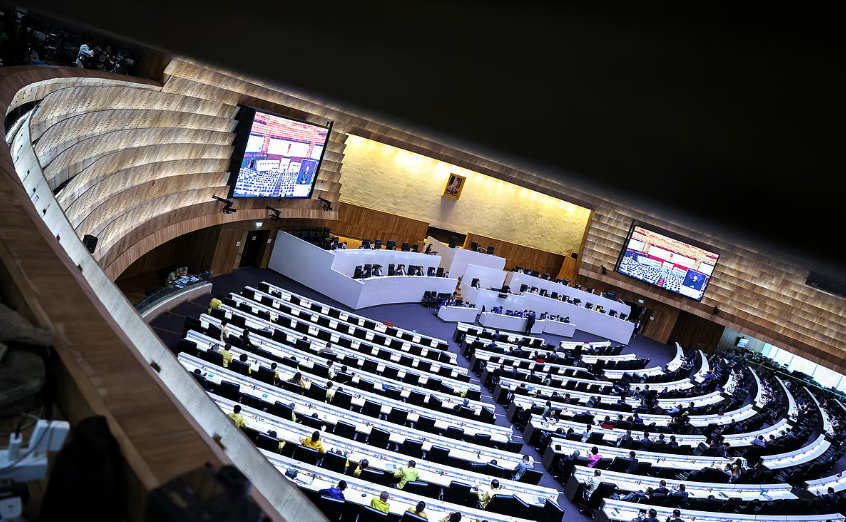
Thailand’s acting prime minister has submitted a decree to dissolve parliament, his party announced on Wednesday, after the country’s largest opposition bloc threw its support behind a rival candidate for the top office.
The announcement came less than a week after former prime minister Paetongtarn Shinawatra was ousted by the Constitutional Court over her handling of a border dispute with Cambodia. Her dismissal created a political vacuum, with competing factions scrambling to form a new government.
Paetongtarn’s Pheu Thai party, which remains in power in a caretaker role, had been seeking an alliance with the influential opposition People’s Party to secure parliamentary backing for its own nominee. But in a surprise move, the People’s Party declared its support for conservative businessman Anutin Charnvirakul.
Soon after, Pheu Thai secretary general Sorawong Thienthong confirmed that acting Prime Minister Phumtham Wechayachai had submitted a decree to dissolve the legislature. “The acting prime minister has submitted a house dissolution decree,” Sorawong told AFP.
Under the Thai constitution, a parliamentary dissolution approved by the king would trigger new elections within 45 to 60 days.
The latest political upheaval underscores the weakening influence of the Shinawatra family, whose Pheu Thai party has dominated Thai politics for two decades but is now struggling to maintain power against the pro-monarchy, pro-military establishment.
The People’s Party has pledged its 143-member bloc to back Anutin, a construction tycoon turned politician who has held senior government positions, including deputy prime minister, interior minister, and health minister. He is best known for steering Thailand’s Covid-19 response and for spearheading the controversial legalization of cannabis in 2022.
Anutin’s political career has not been without controversy. During the pandemic, he drew criticism for comments blaming foreigners for spreading the virus, later issuing a public apology. His Bhumjaithai Party, once a coalition partner of Paetongtarn’s government, withdrew its support earlier this year over her handling of the Cambodia border row — the same issue that ultimately led to her dismissal by the court last Friday for breaching ministerial ethics.
Only five candidates from the 2023 election remain eligible to serve as prime minister, narrowing the field for the kingdom’s next leader. The People’s Party has conditioned its support for Anutin on parliament’s dissolution and fresh elections within four months, meaning his possible ascension to the premiership would likely be short-lived before voters return to the polls.
With the kingdom facing yet another round of political uncertainty, attention now turns to the royal palace. If King Maha Vajiralongkorn endorses the dissolution decree, Thailand will head to the ballot box within two months, prolonging a cycle of instability that has defined its politics for nearly two decades.