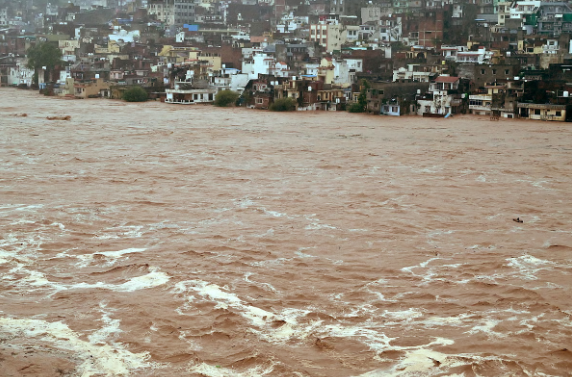
At least 30 people were killed after heavy rains triggered a landslide along the pilgrimage route to the revered Vaishno Devi shrine in northern India’s Jammu region, officials said Wednesday. The disaster struck as torrential downpours battered large parts of Jammu and Kashmir, cutting off communications and forcing authorities to issue safety advisories and shut schools.
The landslide occurred near the Vaishno Devi shrine, one of the most visited Hindu pilgrimage sites in the country, drawing millions of devotees every year. Rescue teams rushed to the site, but officials confirmed that dozens of pilgrims lost their lives when sections of the route collapsed under the force of rain-saturated earth. Local media reported that several others were injured, and efforts were underway to locate missing persons.
The region was lashed by 368 millimeters (14.5 inches) of rain on Tuesday, one of the heaviest single-day downpours in recent years, according to weather officials. The Meteorological Department has warned of more rain in the coming days across the Himalayan belt of Jammu and Kashmir as well as neighboring Ladakh, raising fears of additional landslides, flash floods, and road blockages.
Authorities also ordered the closure of schools and other educational institutions in parts of Jammu, prioritizing public safety as rivers swelled and low-lying areas reported flooding. Residents have been advised to remain indoors, particularly at night, when the risk of accidents from landslides and flooding is greater.
Omar Abdullah, the chief minister of Jammu and Kashmir, confirmed that telecom services had been severely disrupted in the affected areas, making coordination of rescue and relief efforts more difficult. “Communication is almost nonexistent in many districts, which is complicating our response,” Abdullah said, adding that restoration of phone and internet services was being treated as a priority.
The pilgrimage route to Vaishno Devi, located in the Trikuta hills near Katra, typically sees high footfall throughout the year. The latest tragedy highlights the vulnerability of the mountainous terrain to natural disasters, particularly during the monsoon season, when heavy rains often destabilize slopes and trigger landslides.
Officials said teams from the National Disaster Response Force (NDRF), state police, and local volunteers were working together in rescue operations. Helicopters were also being considered to airlift survivors and transport the injured to hospitals if weather conditions allowed.
Prime Minister Narendra Modi expressed condolences to the families of the victims and said the government was monitoring the situation closely. Relief funds and compensation for those affected are expected to be announced once rescue operations are completed.
With rains forecast to continue, authorities have appealed to devotees to postpone their travel plans to the shrine until conditions improve.