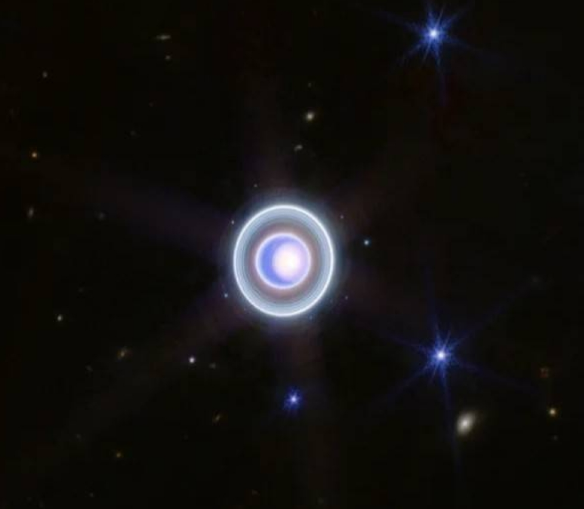
NASA scientists have confirmed the discovery of a previously unknown moon orbiting Uranus, raising the planet’s official count of natural satellites to 29. The find was made using the James Webb Space Telescope (JWST), which detected the small and faint object earlier this year.
The moon, provisionally named S/2025 U1, is estimated to be just 10 kilometers in diameter — tiny compared to many of Uranus’s other moons. Its faint brightness and small size are believed to have kept it hidden from earlier missions, including Voyager 2’s historic 1986 flyby, as well as subsequent ground-based and space telescope observations.
The discovery was first made in February through long-exposure images captured by Webb’s Near-Infrared Camera (NIRCam). The moon was observed orbiting Uranus at a distance of roughly 56,000 kilometers, positioned between the known moons Ophelia and Bianca. Scientists say its nearly circular orbit along the planet’s equatorial plane will provide fresh insights into the complex gravitational interactions within Uranus’s system of rings and satellites.
The research team behind the finding was led by Maryame El Moutamid of the Southwest Research Institute in Texas, working in collaboration with NASA scientists. El Moutamid credited Webb’s unprecedented imaging capabilities for making it possible to spot such a subtle object.
“This discovery is another example of Webb’s ability to reveal details of our solar system that have remained out of reach for decades,” NASA said in a statement.
Uranus, the seventh planet from the Sun, has long fascinated scientists because of its unusual tilt, faint ring system, and diverse collection of moons. While many of its largest moons were first observed in the 18th and 19th centuries, the detection of smaller, irregular satellites has accelerated in recent decades thanks to technological advances in telescopes.
The new discovery underscores Webb’s importance not only as a tool for probing distant galaxies but also for studying planetary systems closer to home. By capturing faint and distant objects in high detail, the telescope is helping astronomers piece together the history and dynamics of the solar system’s more remote planets.
NASA described the find as a significant milestone in ongoing efforts to expand knowledge of Uranus and its environment. Scientists hope that further studies of S/2025 U1 and its orbital neighborhood could shed light on how Uranus’s moons and rings formed and how they continue to evolve under the planet’s gravitational pull.