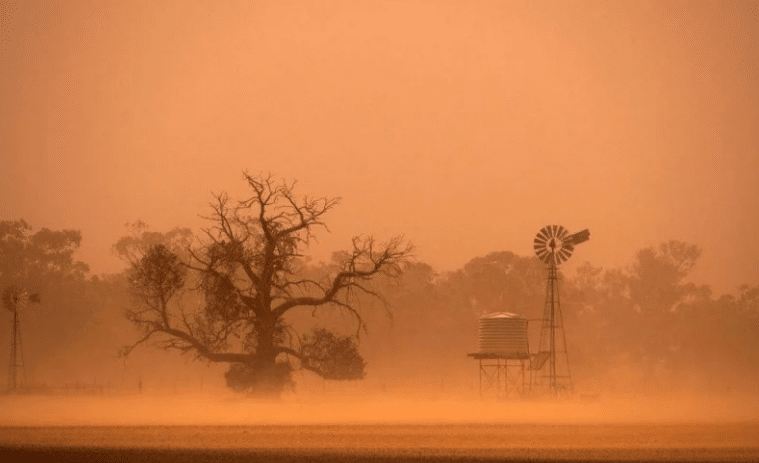
The World Meteorological Organization (WMO) has issued a stark warning about the growing threat of sand and dust storms to global health, economies, and the environment, urging greater investment in forecasting and early warning systems.
In its newly released Annual Airborne Dust Bulletin, the WMO revealed that approximately 330 million people in over 150 countries are affected by sand and dust storms each year. The bulletin comes ahead of the International Day for Combating Sand and Dust Storms, observed on July 12.
According to the report, around two billion tons of sand and dust enter the atmosphere annually, with over 80% originating in the deserts of North Africa and the Middle East. These airborne particles can travel across continents and oceans, impacting regions far beyond their source.
While natural processes drive much of this dust movement, the WMO emphasized that poor land and water management, prolonged droughts, and environmental degradation are increasingly significant contributors.
“Sand and dust storms are not just about dirty windows and hazy skies,” said WMO Secretary-General Celeste Saulo. “They harm the health and quality of life of millions, disrupt air and land transport, damage crops, and reduce solar energy production—costing economies millions of dollars.”
Saulo noted that while the global average surface dust concentration in 2024 slightly declined compared to 2023, certain regions experienced levels well above the historical average for the 1981–2010 period. Key areas affected by long-distance dust transport include the tropical North Atlantic, South America, the Mediterranean, the Arabian Sea, Bay of Bengal, and parts of China.
A newly developed Sand and Dust Storm Index, created jointly by the WMO and World Health Organization, found that nearly half the global population—about 3.8 billion people—was exposed to dust concentrations exceeding WHO safety limits between 2018 and 2022. In heavily affected regions, dust levels exceeded safe thresholds on over 87% of days during that five-year period.
Economic impacts are also rising. A recent study cited in the bulletin estimated that dust and wind erosion cost the United States $154 billion in 2017—over four times more than the cost in 1995. The WMO suggested that the global financial toll is likely far greater, given the lack of comprehensive national-level data.
The United Nations has declared the period from 2025 to 2034 as the Decade for Combating Sand and Dust Storms, aiming to boost international cooperation and resilience against this escalating environmental challenge.