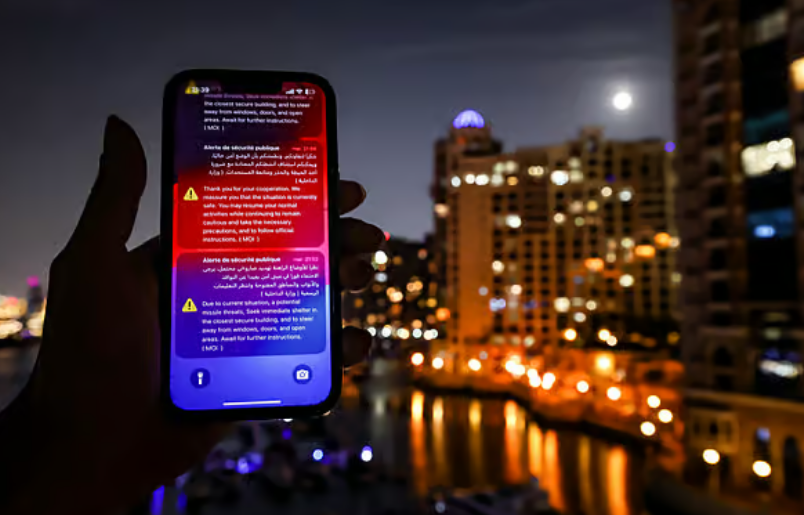
UAE residents received another emergency mobile alert on Tuesday, 37 days after the previous warning, as authorities responded to a missile threat.
The alert instructed people to immediately seek shelter in the nearest secure building, stay away from windows, doors and open areas, and wait for official instructions while air defence systems responded.
Around 10 minutes later, authorities lifted the warning and confirmed that the situation was safe. It was the first emergency mobile alert of this kind since July 12.
For residents, the process may appear simple: an alarm sounds, a message appears with instructions and an all-clear follows. Behind that notification, however, is a nationwide early-warning system designed to deliver urgent information to people in specific locations.
The technology used for these warnings is known as Cell Broadcast. Unlike SMS messages, which are sent individually to telephone numbers, Cell Broadcast sends a notification simultaneously to compatible devices connected to selected mobile-network cells.
Under requirements established by the Telecommunications and Digital Government Regulatory Authority, known as TDRA, UAE-Alert messages can be directed to an area as small as one mobile-network cell or expanded across the entire network.
This geographic system allows authorities to alert people within a particular location without needing their individual phone numbers. The National Emergency Crisis and Disaster Management Authority, or NCEMA, began activating mobile warnings through the National Early Warning System in 2018.
The system was designed to deliver location-based alerts within seconds while allowing normal telecommunications services to continue.
The distinctive emergency sound is also governed by national technical standards rather than being a feature created solely by phone manufacturers.
An Emergency Alert is enabled by default and cannot be switched off by users. It appears on the screen, activates vibration and produces an emergency attention signal lasting 10.5 seconds. TDRA requirements state that the signal can operate even when a device is muted.
The system includes separate categories for emergencies, warnings, tests and exercises, allowing authorities to distinguish between immediate threats and other public notifications.
The technology is compatible with several generations of mobile networks, including GSM, UMTS, LTE and 5G.
The mobile alert is only one stage of the wider response system. The Ministry of Defence operates integrated air-defence and monitoring capabilities, while NCEMA coordinates the national framework for emergency warnings and instructions.
Authorities have previously said national monitoring systems operate continuously and that precautionary warnings can be issued while a potential threat is still being assessed.
Receiving an alert does not necessarily mean an incoming missile or other threat is certain to strike the area where the recipient is located. The system is designed to provide instructions while authorities continue evaluating the situation.
The precise operational process between military detection, threat assessment, emergency coordination and the final transmission of a warning to mobile devices has not been publicly detailed.
What is clear is that several layers work together: threat detection, assessment, authorised emergency communication and geographical delivery through telecommunications networks.
For residents, the system becomes visible only when a phone suddenly vibrates and sounds its distinctive alarm. By then, however, the warning has already passed through a much wider national emergency network, with the handset serving as the final link between authorities and the public.