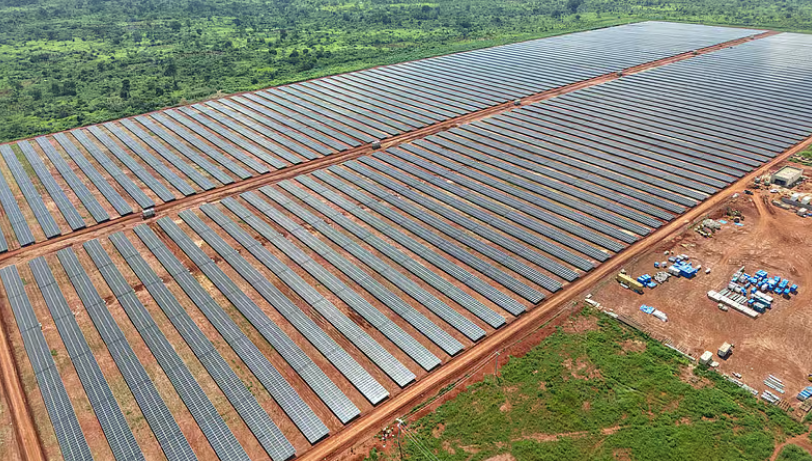
A new 50-megawatt solar power plant near Bangui has begun operations in the Central African Republic, marking a major addition to the country’s limited electricity supply.
Abu Dhabi-based Global South Utilities (GSU) inaugurated the Sakaï solar facility after completing construction in just 10 months. The project includes more than 80,000 solar panels and a 15-megawatt-hour battery storage system.
GSU said the plant is expected to supply clean electricity to more than 300,000 households and prevent more than 50,000 tonnes of carbon dioxide emissions each year.
Ali Alshimmari, managing director and chief executive of GSU, described the project as an important milestone for the country.
“It is a project of historic national importance that will help shape the future of the Central African Republic,” he said.
The size of the facility is modest compared with some of the huge solar projects in the Gulf. Abu Dhabi’s Al Dhafra solar project, for example, has a capacity of 2GW. However, 50MW represents a significant increase for the Central African Republic, where electricity remains unavailable to most of the population.
World Bank figures show that only 18.2 per cent of the country’s population had access to electricity in 2024. In rural communities, access was around 2 per cent.
The country’s power system has faced years of problems linked to limited generation capacity, weak transmission networks and difficulties maintaining and expanding electricity services.
The Sakaï project follows a 25MW solar facility at Danzi, which began operating in 2023 with 25MWh of battery storage. Sakaï doubles the solar generation capacity added by that earlier project.
The battery at Sakaï will allow electricity generated during periods of strong sunlight to be stored and released when required. However, the storage system does not mean the plant can produce its full 50MW output continuously.
Expanding generation is only one part of the challenge. Electricity must also reach homes, businesses, hospitals and other facilities through reliable transmission and distribution networks.
World Bank-supported projects include new 110kV transmission lines connecting the Danzi and Sakaï substations, as well as improvements to distribution infrastructure and efforts to increase household connections.
The project also received support from the Abu Dhabi Fund for Development through concessional financing.
GSU said the Sakaï facility forms part of its wider expansion across Africa and other emerging markets. The company has already developed a solar project in Chad.
For the Central African Republic, however, the significance of Sakaï lies in its potential to strengthen a power system where access to reliable electricity remains one of the country’s major challenges.