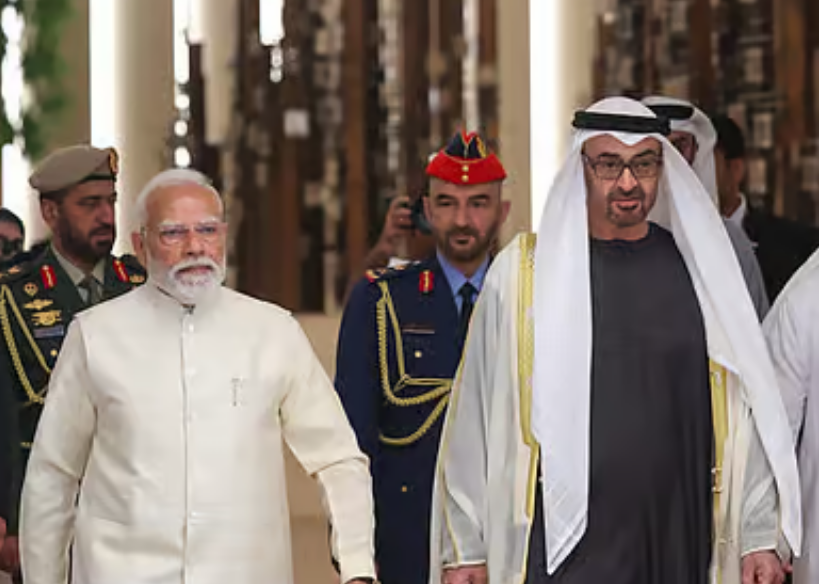
The UAE and India signed a wide-ranging package of agreements covering defence, energy, banking, shipping and advanced technology during Indian Prime Minister Narendra Modi’s visit to Abu Dhabi on Friday, marking another step in the growing economic and strategic partnership between the two countries.
The visit included talks with Mohamed bin Zayed Al Nahyan, where both sides reviewed opportunities to expand cooperation under the Comprehensive Strategic Partnership and the Comprehensive Economic Partnership Agreement.
According to the Indian Embassy in the UAE, Abu Dhabi also committed $5 billion in investments aimed at supporting employment and economic growth in India. Senior Emirati officials attending the meeting included Khalid bin Mohammed bin Zayed Al Nahyan and Hamdan bin Mohammed bin Rashid Al Maktoum, alongside ministers and business representatives from both countries.
One of the largest commercial announcements came from Emirates NBD, which agreed to acquire a 60 per cent stake in RBL Bank in a deal valued at Dh11.02 billion. The transaction follows earlier approvals by the boards of both banks for Emirates NBD to take a controlling position through a major capital infusion.
The investment push also included a Dh3.67 billion commitment by Abu Dhabi Investment Authority into India’s National Investment and Infrastructure Fund. Another agreement will see International Holding Company acquire a stake in India’s Samman Capital.
Energy cooperation featured heavily during the visit. India’s Strategic Petroleum Reserves Limited signed an agreement with Abu Dhabi National Oil Company to expand India’s strategic oil reserves and explore collaboration in liquefied natural gas and liquefied petroleum gas storage infrastructure.
A separate LPG agreement was signed to strengthen long-term supply arrangements and improve energy security for both countries amid continued volatility in global energy markets.
The two governments also agreed on a framework for a strategic defence partnership designed to deepen industrial cooperation, support innovation and encourage technology sharing in areas linked to national and regional security.
In the maritime sector, both countries approved plans for a ship repair cluster at Vadinar in India, alongside a skills development initiative aimed at improving training for India’s maritime workforce.
Another significant announcement focused on artificial intelligence and computing infrastructure. India’s Centre for Development of Advanced Computing and UAE-based G42 signed an agreement to establish eight exaflop-scale supercomputer clusters, strengthening cooperation in high-performance computing and advanced digital technologies.
The agreements reflect the growing economic ties between the UAE and India, with both countries seeking deeper collaboration across finance, energy, infrastructure and emerging technologies.