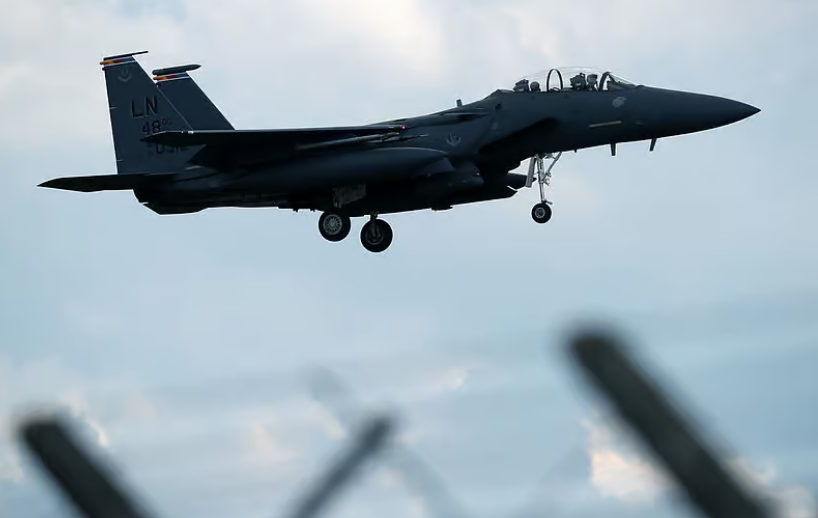
Iranian and American forces raced each other on Saturday to locate and recover a crew member from the first US fighter jet reported downed inside Iran since the start of the war, as hostilities continued to spread across the Middle East.
Tehran said it had shot down an F-15 warplane in central Iranian airspace, claiming the aircraft was destroyed by its air defence systems. US media reported that American special forces had rescued one of the two crew members, while the second remained missing. Iran’s military also said it had downed a US A-10 aircraft in the Gulf, with US reports indicating that pilot was safely recovered.
The conflict began more than a month ago with joint US-Israeli strikes on Iran, which killed supreme leader Ali Khamenei and triggered a wave of retaliation across the region. Since then, the war has disrupted global markets, strained energy supplies and affected millions.
The US Central Command did not immediately comment on the reported loss of the F-15. White House Press Secretary Karoline Leavitt said only that the president had been briefed. President Donald Trump, speaking to NBC, dismissed concerns that the incident would affect negotiations with Tehran, saying, “No, not at all. No, it’s war.”
An Iranian military spokesperson said “an American hostile fighter jet in central Iranian airspace was struck and destroyed,” adding that search operations were ongoing. Iranian state television reported that anyone who captured a crew member alive would “receive a valuable reward.”
Military analysts said downed pilots are trained to evade capture after ejecting. Retired US brigadier general Houston Cantwell said survival training focuses on concealment until rescue arrives.
Meanwhile, fighting intensified across multiple fronts. Explosions were reported in northern Tehran, where strikes have increasingly targeted economic and industrial areas. An AFP journalist near a damaged bridge west of the capital saw residential buildings with shattered windows. Iranian officials said the attack killed 13 civilians and wounded dozens.
Iran has also tightened control over the Strait of Hormuz, through which about one-fifth of global oil and gas supplies normally pass. The move has raised fears of further disruption to energy markets. Iranian officials warned of more attacks on regional energy infrastructure in response to US threats. A drone strike on a Kuwaiti refinery caused fires, while another attack damaged a power and desalination facility.
Elsewhere, Israel said it had struck thousands of targets in Lebanon over the past month, including bridges in the Bekaa region to disrupt supply routes. Explosions were heard in Beirut early Saturday, with smoke rising over parts of the city. Lebanese authorities report more than 1,300 people killed and thousands injured since the fighting began.
As the conflict widens, diplomatic efforts remain uncertain. Former Iranian foreign minister Mohammad Javad Zarif suggested Tehran could negotiate limits on its nuclear programme and reopen key shipping routes in exchange for sanctions relief. For now, the search for the missing pilot underscores the human toll of a war showing little sign of slowing.