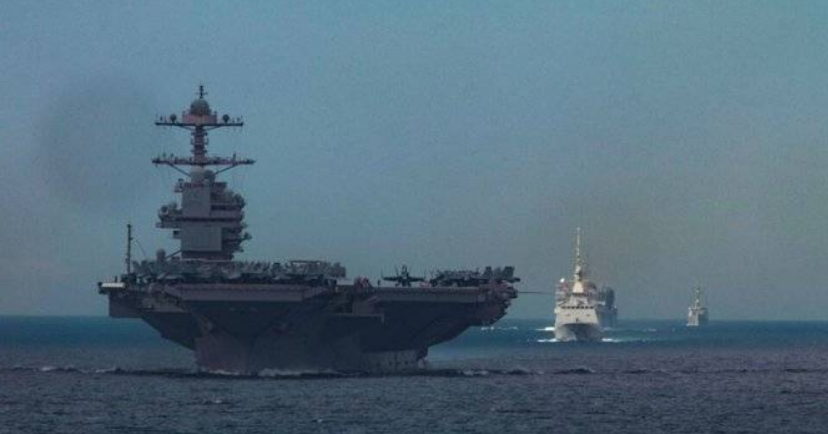
The United States’ most advanced aircraft carrier, the USS Gerald R. Ford, has entered the Caribbean Sea as part of what Washington calls an expanded counter-narcotics mission, heightening tensions with Venezuela as both countries increase military activity in the region.
The movement of the carrier strike group represents the peak of what officials describe as the largest U.S. naval buildup in the Caribbean in decades. Nearly 12,000 American personnel are now deployed across close to a dozen Navy vessels under “Operation Southern Spear,” a campaign announced by U.S. Defense Secretary Pete Hegseth to target drug trafficking networks.
U.S. Southern Command said the Ford and its accompanying warships transited the Anegada Passage near the British Virgin Islands on Sunday. The strike group includes several fighter jet squadrons and guided-missile destroyers. Rear Adm. Paul Lanzilotta, who commands the carrier group, said the deployment strengthens U.S. capabilities to protect national interests against what he described as “narco-terrorism” in the Western Hemisphere.
Since August, the United States has significantly expanded its maritime presence, adding six warships to the region. U.S. forces have also carried out a series of strikes in international waters against about 20 vessels they claim were involved in smuggling operations. Washington says the actions resulted in the deaths of at least 76 people, though officials have not released evidence showing the vessels were tied to drug trafficking, prompting questions from regional observers and human rights groups.
The escalating U.S. presence has drawn sharp condemnation from Venezuelan President Nicolás Maduro. He has accused Washington of using anti-drug missions as a cover to promote regime change in Caracas and to gain influence over Venezuela’s extensive oil reserves. Maduro has long argued that U.S. sanctions and diplomatic pressure are part of a broader effort to undermine his government.
On Tuesday, Venezuela’s armed forces announced what they termed “massive” nationwide deployments, framing the move as a defensive response to what the government calls American aggression. The announcement included warnings about protecting national sovereignty and maintaining readiness amid growing military activity near Venezuelan waters.
The U.S. insists the operations are solely aimed at combatting drug trafficking networks that it says threaten American communities and regional stability. But the show of force, coupled with Venezuela’s counter-mobilization, has sparked concerns about potential miscalculations in an already volatile environment.
Diplomats across Latin America are monitoring the situation closely as both nations signal they are prepared to maintain — and possibly escalate — their military posture in the Caribbean.