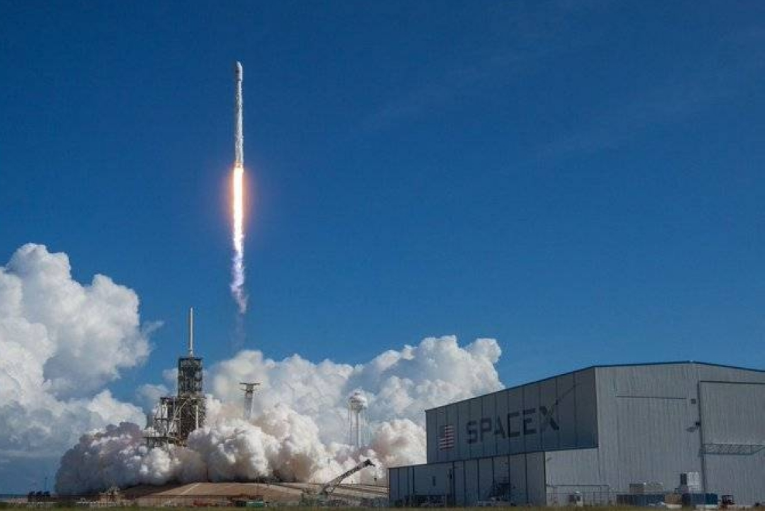
SpaceX successfully launched the U.S. Space Force’s X-37B spaceplane on Friday, marking the start of its eighth mission and reinforcing the company’s role as a key partner in American space exploration and defense initiatives.
In an official statement, SpaceX confirmed that the launch was conducted using its Falcon 9 rocket from NASA’s Kennedy Space Center in Florida. The mission began with a flawless liftoff, and just 8.5 minutes later, the rocket delivered its payload into low Earth orbit. The reusable first stage of Falcon 9 then executed a controlled landing on a floating platform in the Atlantic Ocean, continuing the company’s track record of reusability and cost efficiency in spaceflight.
The X-37B spaceplane, often referred to as an “orbital test vehicle,” is an autonomous spacecraft measuring 8.8 meters (29 feet) in length. Its design draws inspiration from NASA’s now-retired space shuttle program but in a smaller, unmanned configuration. The spacecraft is built to conduct long-duration missions in orbit and is capable of returning to Earth for reuse, making it a critical asset for experimentation and advanced testing.
According to the U.S. Space Force, the primary role of the X-37B is to serve as a platform for developing and evaluating new technologies, sensors, and systems that can later be integrated into future defense and civilian space programs. The spaceplane has been instrumental in testing cutting-edge materials, autonomous flight operations, and advanced payload deployment techniques.
Friday’s launch highlights the growing emphasis on military space operations, as the Space Force continues to expand its research and capabilities beyond Earth’s atmosphere. While details of the X-37B’s specific objectives on this mission remain classified, previous flights have included experiments related to solar power generation, reusable satellite systems, and materials testing under prolonged exposure to space conditions.
The reusable nature of both the Falcon 9 rocket and the X-37B spacecraft underscores a broader shift in the U.S. approach to space exploration, where cost reduction and efficiency are prioritized alongside scientific and defense-driven goals. Each successful mission adds valuable data for both government agencies and private sector partners as they push the boundaries of space technology.
This latest launch further cements SpaceX’s reputation as a reliable contractor for high-profile missions, ranging from commercial satellite deployments to government research projects. With the X-37B now in orbit, analysts suggest the mission will likely extend for months, if not longer, given the spacecraft’s proven ability to remain in space for extended periods.
The launch marks another milestone in the partnership between the U.S. Space Force and SpaceX, demonstrating how public-private collaboration continues to shape the future of space research, security, and exploration.