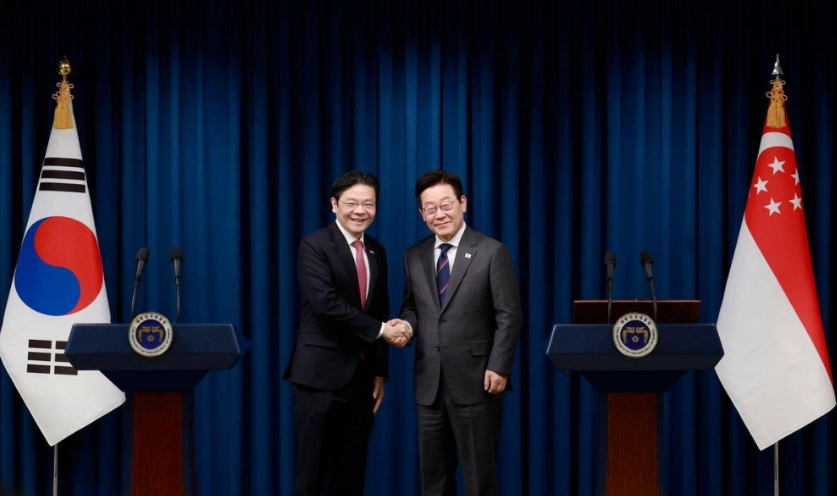
South Korea and Singapore have agreed to elevate their bilateral relationship to a strategic partnership, pledging to deepen cooperation in defense, trade, and emerging technologies. The announcement came Sunday following summit talks between South Korean President Lee Jae Myung and Singaporean Prime Minister Lawrence Wong at the presidential office in Seoul.
The leaders said the new partnership reflects their shared commitment to closer collaboration amid a rapidly evolving global landscape. “Our two countries share many similarities. We have both achieved remarkable growth based on human capital and an open, free-trade order despite limited land, scarce resources, and a challenging geopolitical environment,” President Lee said at a joint press conference.
According to South Korea’s presidential office, the partnership will focus on expanding cooperation across several strategic sectors — including security, defense, artificial intelligence, and advanced technology — while also tackling transnational issues such as cybercrime and online scams.
The agreement also underscores a shared interest in addressing global challenges such as climate change and cross-border criminal networks. Both countries pledged to work together to maintain a rules-based international order that supports peace and economic stability.
Prime Minister Wong emphasized that Singapore and South Korea are “natural partners” in building a sustainable and innovative future. He identified the green economy, digital innovation, and defense collaboration as key areas of potential growth. “There are significant opportunities for our nations to work together in building a resilient, future-ready partnership,” Wong said, expressing his support for Seoul’s efforts to promote lasting peace on the Korean Peninsula.
The strategic partnership marks a new chapter in bilateral ties that have steadily grown since the establishment of diplomatic relations in 1975. It is expected to create new momentum for trade and investment between two of Asia’s most advanced economies, both of which have relied heavily on technology-driven growth and global supply chain integration.
Officials said the partnership will also encourage greater people-to-people exchanges, academic collaboration, and cultural engagement — strengthening mutual understanding and trust between the two nations.
As both countries navigate shifting geopolitical dynamics in the Indo-Pacific, the new framework is seen as a reaffirmation of their shared commitment to openness, innovation, and regional stability.