Newly released commercial satellite images indicate that the U.S. airstrike on Iran’s Fordow nuclear facility may have caused severe damage, potentially destroying the deeply buried site and the uranium-enriching centrifuges within. However, experts caution that confirmation of the underground destruction remains uncertain due to the facility’s fortified depth.
David Albright, a former UN nuclear inspector and head of the Institute for Science and International Security, said the U.S. appears to have used GBU-57/B Massive Ordnance Penetrator (MOP) bombs—designed to breach hardened underground targets. “They just punched through with these MOPs,” he said. “I would expect that the facility is probably toast.”
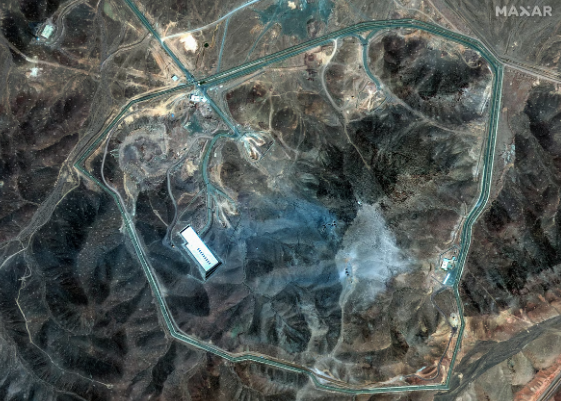
Fordow, carved into the side of a mountain near Qom, was considered one of Iran’s most secure nuclear sites. Satellite imagery from Maxar Technologies shows six distinct impact craters, suggesting a direct hit from the 30,000-pound bombs. Still, Decker Eveleth, a researcher at CNA Corporation, noted that the hall housing the centrifuges is “too deeply buried for us to evaluate the level of damage based on satellite imagery.”
The operation, dubbed “Midnight Hammer,” also targeted other nuclear facilities, including Natanz and Isfahan—both central to Iran’s uranium enrichment programme. Israel had previously struck surface-level infrastructure at these locations during its 10-day conflict with Iran.
Experts now warn that Iran may have pre-emptively relocated sensitive materials. Satellite photos captured “unusual activity” at Fordow in the days leading up to the strike, with a long queue of vehicles seen at the facility. A senior Iranian official told Reuters that much of the 60% enriched uranium had been moved to an undisclosed location.
“There’s almost certainly facilities that we don’t know about,” said Jeffrey Lewis of the Middlebury Institute. “You can set them back by a few years, but you can’t erase the program.”
Iran’s parliament has threatened to withdraw from the Nuclear Non-Proliferation Treaty (NPT), a cornerstone of global arms control, and end cooperation with the International Atomic Energy Agency (IAEA). Daryl Kimball of the Arms Control Association warned: “The world is going to be in the dark about what Iran may be doing.”
General Dan Caine, Chairman of the U.S. Joint Chiefs of Staff, confirmed that seven B-2 bombers deployed 14 MOPs in a “double tap” strike—an initial wave followed by a second round in the same locations. He described the damage as “extremely severe” but declined to speculate whether Iran’s nuclear capabilities were fully neutralized.
Experts say the attacks, while tactically significant, may only be a temporary setback to Iran’s program. With new facilities planned in Isfahan and the potential dispersal of critical components, questions remain about what the long-term strategic impact will be—and how Iran might retaliate.