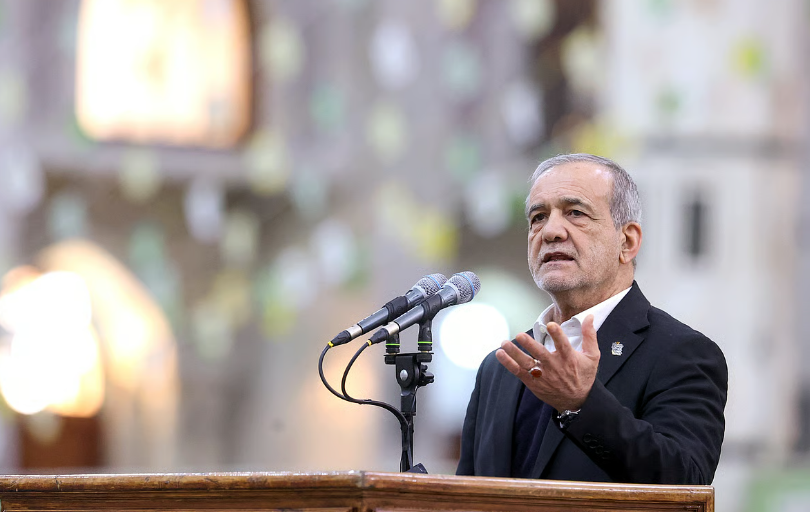
Iran’s Supreme Leader has prohibited the development of weapons of mass destruction, a move that “clearly means Tehran won’t develop nuclear weapons,” President Masoud Pezeshkian said on Thursday, ahead of a fresh round of negotiations with the United States.
Pezeshkian’s remarks came as Iranian and US officials prepared for a third round of talks in Geneva aimed at easing tensions over Tehran’s nuclear programme. Washington has long accused Iran of seeking to build nuclear weapons, an allegation Iranian authorities continue to reject.
Iran’s Supreme Leader, Ayatollah Ali Khamenei, who holds final authority over state matters including nuclear policy, issued a fatwa in the early 2000s banning the development and use of nuclear weapons. Iranian officials have repeatedly cited the religious decree as proof that the country’s nuclear activities are for peaceful purposes.
The latest diplomatic effort comes amid heightened regional tensions and a significant US military presence in the region. Both sides are seeking to prevent further escalation and address a dispute that has persisted for decades.
According to US officials, Special Envoy Steve Witkoff will attend the indirect discussions alongside Jared Kushner, son-in-law of former President Donald Trump. Iran will be represented by Foreign Minister Abbas Araqchi. The talks are being mediated by Oman’s Foreign Minister Badr Albusaidi.
The negotiations follow earlier discussions held in Geneva last week. Officials say the meetings are designed to narrow differences and explore possible frameworks for an agreement that would limit Iran’s nuclear activities in exchange for sanctions relief.
On Wednesday evening, Araqchi met Albusaidi to review proposals Iran intends to present during the talks. In a statement posted on X by Oman’s foreign ministry, Albusaidi confirmed his role in conveying messages between the two sides.
Albusaidi is expected to meet the US delegation on Thursday morning before relaying Washington’s position to Iranian officials. The talks remain indirect, with Omani diplomats shuttling between the delegations.
Western governments and Israel maintain that Iran’s nuclear programme could be diverted toward military purposes. Tehran insists its activities are strictly civilian, focused on energy production and medical research.
As discussions resume in Geneva, both sides face pressure to produce tangible progress. For Iran, easing economic sanctions remains a priority, while the United States is seeking assurances that Tehran’s nuclear programme will not advance toward weaponisation.