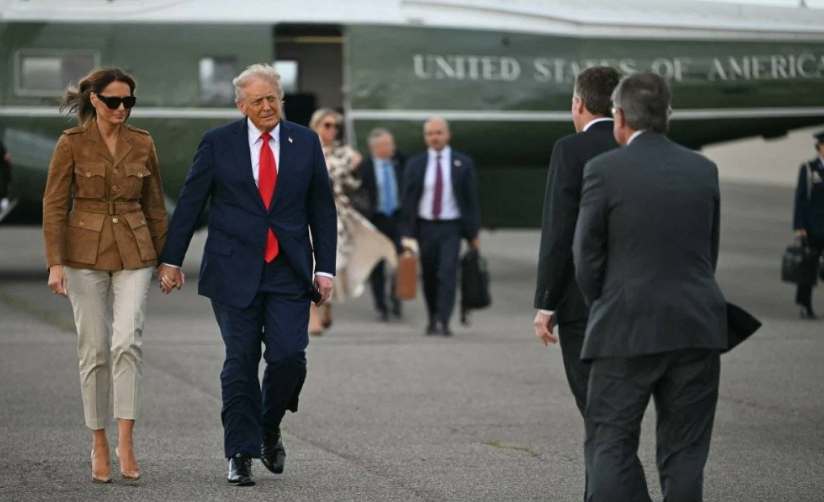
Marine One, the helicopter transporting U.S. President Donald Trump and First Lady Melania Trump, made an unscheduled landing in the United Kingdom on Wednesday after experiencing what officials described as a “minor hydraulic issue.”
The helicopter was carrying the President and First Lady from Chequers, the Prime Minister’s country residence in Buckinghamshire, to Stansted Airport, where they were due to board Air Force One for their return flight to Washington. According to the White House, the aircraft diverted to a nearby local airfield shortly after departure.
White House Press Secretary Karoline Leavitt confirmed the precautionary landing in a statement, emphasizing that the maneuver was made “out of an abundance of caution.” She stressed that at no point were the President or First Lady in danger.
“Both President Trump and First Lady Melania Trump safely disembarked Marine One and immediately transferred to a backup helicopter,” Leavitt said. “The backup aircraft then completed the journey to Stansted without further issue.”
While no injuries were reported, the incident caused a brief delay in the President’s schedule. Air Force One, which had been waiting at Stansted, departed later than planned but eventually took off for the United States with the Trumps on board.
Hydraulic issues, though uncommon, can affect a helicopter’s flight controls, landing gear, or other critical systems. Aviation experts note that military aircraft such as Marine One are equipped with multiple redundancies and undergo rigorous maintenance, reducing the likelihood of serious complications. The White House did not specify the exact nature of the malfunction but confirmed that an inspection of the helicopter was underway.
Marine One is a call sign used for any U.S. Marine Corps aircraft carrying the President. The fleet typically consists of modified Sikorsky VH-3D Sea Kings and VH-60N White Hawks, specially designed with advanced safety, communications, and defensive systems. In line with long-standing security protocols, Marine One always travels in a group of identical helicopters to obscure which aircraft the President is aboard. A backup is routinely available in case of technical difficulties such as Wednesday’s incident.
The episode marked a rare but not unprecedented disruption in Marine One’s operations. Previous administrations have occasionally faced minor technical setbacks requiring backup helicopters, though such events are generally resolved quickly without impact on presidential security.
Despite the precautionary diversion, officials stressed that the President’s safety was never compromised and his travel plans proceeded with only minimal delay.