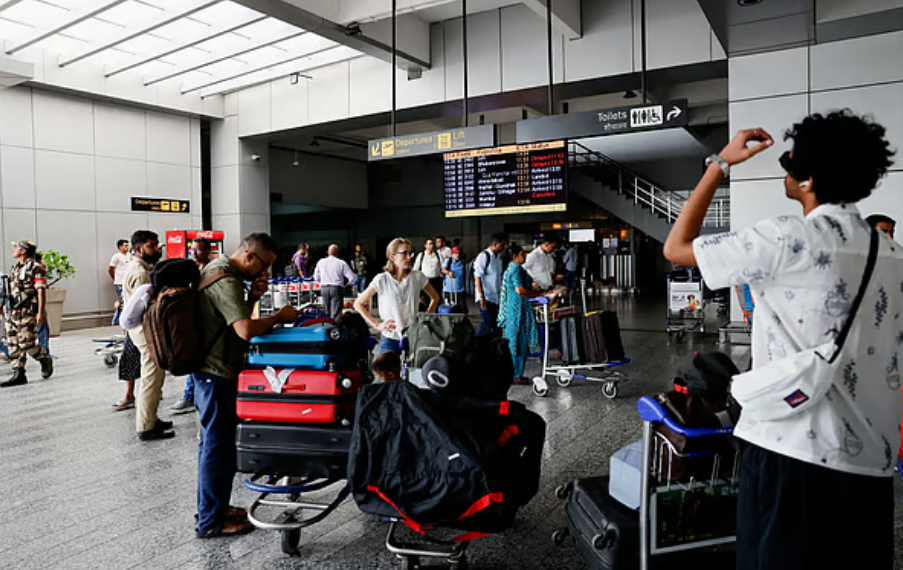
The Airports Authority of India (AAI) announced late on Friday that the system used to generate flight plans is now “up and running,” following a major technical glitch that disrupted hundreds of flights at Delhi airport for more than a day.
The malfunction, which began around 6 p.m. on Thursday, forced air traffic controllers to manually process flight plans, leading to cascading delays across one of the world’s busiest airports. According to officials, at least 200 flights were delayed on Friday alone as airlines struggled to manage schedules amid the outage.
AAI confirmed that the issue was detected in its IP-based Automatic Message Switching System (AMSS), a crucial network used to prepare and transmit flight plans. In a post on X, the agency said the system had been restored but warned it would take time to clear the backlog and return to normal operations.
The disruption caused chaos for both domestic and international carriers. IndiGo, India’s largest airline, saw its shares fall by 2% on Friday, while SpiceJet dropped by 1%, as both companies, along with Air India Group, cautioned passengers about ongoing delays that could spill over into Saturday.
“Due to the technical issue in the AMSS, controllers had to manually develop flight plans, which significantly slowed down the process,” an official familiar with the situation said. “We expect it will take several more hours before operations fully stabilise.”
In an effort to mitigate the delays, some airlines took the unusual step of deploying their own staff to assist air traffic controllers in manually generating flight plans. Air India Express was among those that stationed personnel in control rooms to help keep operations moving.
The glitch caused at least 25 flight departures to be delayed on Thursday and more than 175 on Friday. Data from tracking service Flightradar24 showed the average departure delay reached 60 minutes by Friday evening. Delhi airport typically handles 60 to 70 aircraft movements every hour, underscoring the scale of disruption caused by the failure.
Several international flights were also affected, including an ITA Airways service to Rome, which was delayed by nearly two hours, and a Virgin Atlantic flight to London, which departed more than an hour late.
Delhi airport, operated by GMR Airports, managed approximately 78 million passengers in 2024, making it the ninth busiest airport globally, according to Airports Council International. While the cause of the system failure remains unclear, the incident follows a recent ransomware attack that affected several major European airports in September, raising renewed concerns about the vulnerability of aviation technology systems.