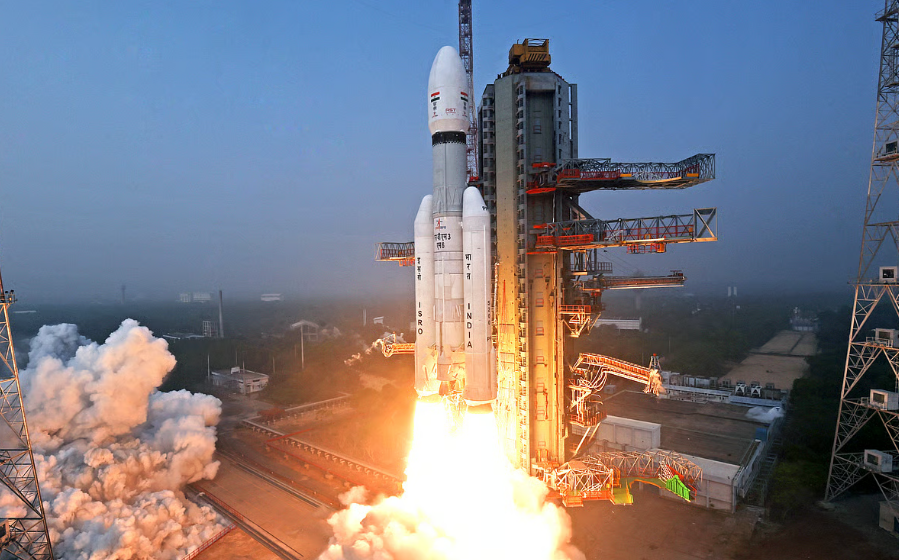
India’s space agency launched its heaviest ever payload on Wednesday, a milestone that Prime Minister Narendra Modi described as “a significant stride” for the country’s space sector. The LVM3-M6 rocket carried the US-built AST SpaceMobile communications satellite into low-Earth orbit, marking what the Indian Space Research Organisation (ISRO) called the “heaviest payload to be launched from Indian soil.”
Weighing 6,100 kilograms (13,448 pounds), the satellite was launched on a modified version of a rocket that India intends to use for future missions, including uncrewed orbital flights and human spaceflight. The launch highlights India’s expanding capabilities in heavy-lift rocket technology and its growing role in the global commercial satellite market.
Modi said the mission was “a proud milestone in India’s space journey” and noted that it “strengthens India’s heavy-lift launch capability and reinforces our growing role in the global commercial launch market.”
Earlier this year, ISRO launched the CMS-03 communication satellite, which weighed around 4,410 kilograms. The LVM3-M6 launch builds on that effort, using an upgraded rocket originally deployed to send an unmanned craft to the Moon in August 2023.
India is positioning itself to gain a larger share of the commercial satellite sector as companies worldwide seek advanced communication infrastructure. The country’s cost-effective approach to space exploration has allowed it to compete with established powers, achieving complex missions at a fraction of the typical expense.
In addition to commercial objectives, India has ambitious plans for human spaceflight. ISRO aims to conduct an uncrewed orbital mission before its first crewed mission in 2027. Modi has also announced intentions to send an astronaut to the Moon by 2040.
Over the past decade, India has steadily expanded its space programme, combining domestic scientific progress with commercial partnerships. The launch of the AST SpaceMobile satellite not only demonstrates India’s technical capabilities but also underscores its intent to play a major role in the increasingly competitive global space industry.
As countries around the world invest in satellite communications and space infrastructure, India’s achievements position it as a key player in both government-led and commercial space missions. Analysts say the nation’s ability to deliver high-capacity payloads at lower costs could attract further international collaborations in the years ahead.