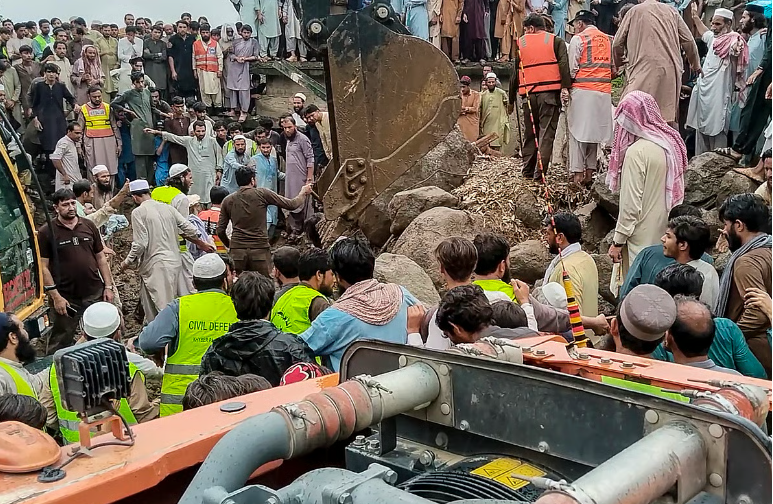
Rescue operations were underway across northern Pakistan on Saturday after flash floods triggered by relentless monsoon rains killed at least 321 people in just 48 hours, authorities confirmed.
The heaviest toll came from Khyber Pakhtunkhwa province, where 307 people, including 15 women and 13 children, lost their lives. The Provincial Disaster Management Authority said most victims were swept away by sudden floods or buried in collapsed homes. At least 23 others were injured, while rescue workers continued to search for bodies trapped under debris.
Around 2,000 personnel have been deployed in nine flood-hit districts, though operations have been severely hampered by ongoing rains, washed-out roads, and frequent landslides. “Heavy rainfall, landslides in several areas, and damaged roads are causing significant challenges in delivering aid,” Bilal Ahmed Faizi, a spokesman for the provincial rescue agency, told AFP. “In most areas, our workers are travelling on foot to reach remote villages.”
The provincial government declared six mountainous districts—Buner, Bajaur, Swat, Shangla, Mansehra, and Battagram—as disaster zones. With rains forecast to continue, the meteorological department issued fresh alerts urging people in the northwest to take precautions.
Elsewhere, nine people died in Pakistan-administered Kashmir, and five in Gilgit-Baltistan, according to the National Disaster Management Authority. Another five people, including two pilots, were killed when a government helicopter crashed in poor weather while on a relief mission.
For many survivors, the devastation felt apocalyptic. “I heard a loud noise as if the mountain was sliding. The ground was trembling like it was the end of the world,” said Azizullah, a resident of Buner, where dozens were killed. “It felt like death was staring me in the face.”
In Bajaur, residents gathered around excavators digging through mud-soaked hillsides in search of loved ones. Funeral prayers were offered on Friday for victims laid out under makeshift coverings, as grief-stricken families mourned.
The monsoon season, which delivers about three-quarters of South Asia’s annual rainfall, is vital for agriculture but also brings widespread destruction. This year’s rains began earlier than usual and are expected to last longer, according to disaster officials. “The next 15 days will see further intensification,” warned agency representative Syed Muhammad Tayyab Shah.
Pakistan has already recorded more than 600 monsoon-related deaths this summer. In Punjab province alone, rainfall in July was 73 percent higher than last year, causing more fatalities than the entire previous season.
The country remains acutely vulnerable to climate change, with increasingly severe weather disasters striking its 255 million people. The 2022 monsoon floods, which killed around 1,700 and submerged a third of the nation, remain a painful memory.
In Buner, schoolteacher Saifullah Khan, 32, joined fellow villagers in searching through rubble. “I helped retrieve the bodies of the children I taught,” he said. “We don’t even know who is alive and who is dead. The entire area is reeling from trauma.”