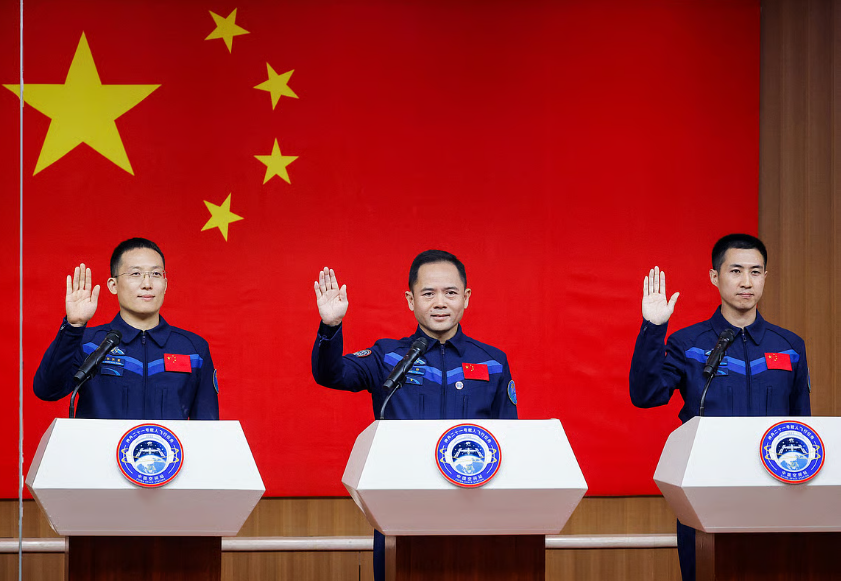
China is set to send its youngest astronaut into orbit on Friday as part of the Shenzhou-21 mission to the Tiangong space station, marking another milestone in the country’s rapidly advancing space programme.
The China Manned Space Agency (CMSA) announced that astronauts Zhang Lu, Zhang Hongzhang, and Wu Fei will lead the upcoming mission, scheduled to launch at 11:44 p.m. local time (1544 GMT) from the Jiuquan Satellite Launch Centre in Gansu province.
At 32, flight engineer Wu Fei will become the youngest Chinese astronaut to embark on a space mission. “I feel incomparably lucky,” Wu said during a pre-launch press conference on Thursday. “Being able to integrate my personal dreams into the glorious journey of China’s space programme is the greatest fortune this era has bestowed upon me.”
Commanding the mission will be 48-year-old Zhang Lu, a veteran space pilot who previously flew on the Shenzhou-15 mission more than two years ago. The third crew member, Zhang Hongzhang, 39, will serve as the mission’s payload specialist.
The crew will be joined by four special passengers — two male and two female lab mice — as part of China’s first in-orbit experiments involving rodents. The CMSA said the tests will help researchers better understand the effects of microgravity on biological systems, advancing scientific studies related to long-term space habitation.
“The team will report back to our motherland and its people with complete success,” Commander Zhang Lu said, expressing confidence ahead of the launch.
The Tiangong space station, permanently crewed by rotating teams of three astronauts every six months, stands as the centrepiece of China’s multibillion-dollar bid to rival the achievements of the United States and Russia in space exploration.
Under President Xi Jinping, China has significantly accelerated its space ambitions, achieving historic milestones such as landing robotic rovers on both the Moon and Mars. Beijing has pledged to send astronauts to the lunar surface by 2030, with plans to eventually build a base on the Moon.
The CMSA reaffirmed that target on Thursday, noting ongoing preparations for the effort, including tests of its new Lanyue lunar lander and Mengzhou manned spacecraft.
With the Shenzhou-21 mission, China continues to solidify its position as a global space power, advancing closer to its goal of establishing a long-term human presence beyond Earth’s orbit.