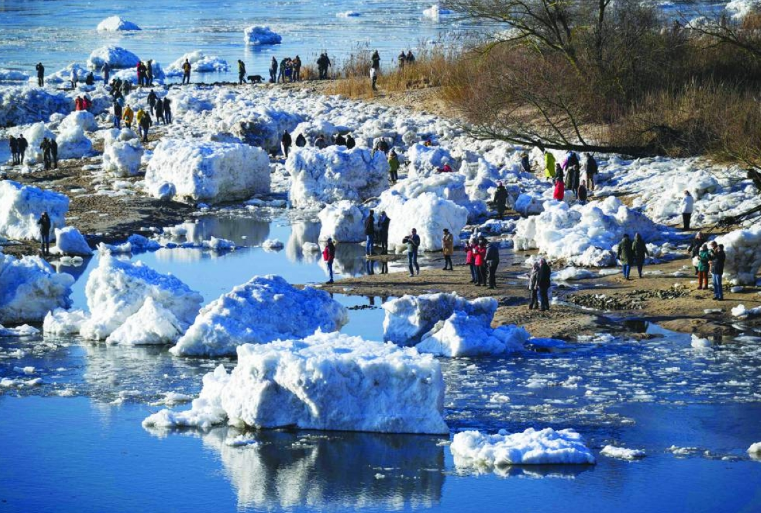
Residents and visitors gathered along the banks of the Elbe River on Tuesday to witness an unusual winter spectacle as massive Arctic-style ice floes drifted downstream and piled up near a barrage close to Hamburg. The frozen sheets, formed during a recent cold snap, have disrupted river traffic while turning the normally busy waterway into a temporary tourist attraction.
The ice developed upstream over several weeks when temperatures plunged to as low as minus 15 degrees Celsius. As the cold tightened its grip, thick layers of ice spread across wide sections of the river. Icebreakers were later deployed to clear navigation routes, breaking the frozen surface into large slabs that continued their journey toward northern Germany.
“Icebreakers have since smashed through the ice, sending the floes downstream where they accumulated at a barrage at Geesthacht, near the river-port of Hamburg,” said Tilman Treber from the federal navigation authority (WSV).
By Tuesday morning, the floating blocks had gathered in dense clusters near the barrage, forming towering piles that reminded many observers of scenes usually associated with far northern regions. Families, photographers and local residents lined the riverbanks to capture images and videos of the icy buildup, which glittered under pale winter sunlight.
For shipping operators, the spectacle has been less welcome. River traffic along parts of the Elbe has faced delays as authorities assess the safest way to move vessels through the affected sections. Officials said the ice does not pose an immediate flood risk but warned that shifting floes could damage smaller craft or river infrastructure.
“We are closely monitoring the situation,” Treber added, noting that water levels remain stable and that crews are prepared to intervene if conditions change. He said the accumulation was a natural consequence of the recent freeze and subsequent clearing operations upstream.
Local businesses near the river reported an unexpected boost in foot traffic as people travelled from surrounding towns to see the rare scene. Cafés and riverfront viewpoints filled quickly, with many visitors comparing the view to images from the Arctic Circle rather than northern Germany.
Meteorologists said the cold spell that caused the ice formation was one of the sharpest in recent winters, though temperatures have since begun to rise slightly. As milder weather continues, authorities expect the floes to gradually break apart and drift onward, easing pressure on the barrage and restoring normal river flow.
Environmental experts noted that while winter ice on the Elbe is not unprecedented, the size and density of the floes this year are striking. They said such events highlight how quickly river systems can respond to sudden shifts in temperature.
For now, the frozen display remains both a logistical challenge and a fleeting attraction. Visitors continued to line the riverbanks on Tuesday afternoon, aware that the icy panorama could vanish as quickly as it arrived, carried away by the steady current of one of Germany’s most important waterways.