Government shutdowns have become a familiar outcome of political deadlock in Washington, as disagreements over federal spending repeatedly disrupt public services. A new partial shutdown could begin at midnight on January 31 after Senate Democrats and Republicans failed to reach agreement on a funding package tied to immigration enforcement.
The latest standoff centers on a six-part appropriations bill that includes funding for the Department of Homeland Security (DHS). Senate minority Democrats have said they will not allow the bill to advance unless the DHS section is removed or amended to restrict immigration enforcement activities backed by President Donald Trump. Senate Republicans oppose splitting the package, but because Democrats can block final passage, Republicans must secure the support of at least seven Democratic senators to move the bill forward.
The US government operates on 12 annual appropriations bills that must be passed by Congress and signed by the president. When lawmakers miss the October 1 start of the fiscal year, they typically rely on temporary measures known as continuing resolutions to keep agencies running. If those stopgap measures expire without a replacement, a funding gap occurs and agencies must begin shutdown procedures.
Trump has already signed six appropriations bills for fiscal year 2025, funding parts of the government through September 30. The remaining agencies are operating under a continuing resolution that expires January 30. The House-passed funding package before the Senate would finance those agencies for the rest of the fiscal year.
Departments affected include Defense, Homeland Security, State, Treasury, Transportation, Health and Human Services, and Housing and Urban Development. Smaller agencies such as the Small Business Administration, the Securities and Exchange Commission, and the White House are also included.
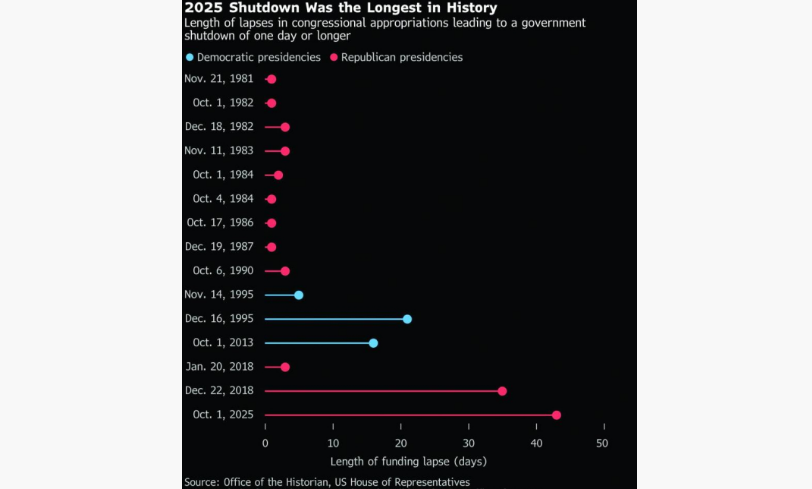
The most recent shutdown began in October 2025 and lasted 43 days, making it the longest in US history. It was the third shutdown under Trump across his two terms and the 15th funding lapse since modern budget rules took effect in 1981. The second-longest shutdown, lasting 35 days in 2018 and 2019, stemmed from a dispute over funding for a border wall.
A shutdown suspends many government functions and places non-essential federal employees on furlough, while essential workers continue without pay until funding is restored. Military operations, air traffic control, veterans’ medical care, and federal law enforcement remain active. Federal workers are guaranteed back pay once the government reopens.
If a shutdown occurs, non-essential Pentagon staff would be furloughed, the State Department would likely reduce routine passport and visa services, and DHS employees, including Transportation Security Administration officers, would work without pay. The Internal Revenue Service would lose funding at the start of tax season, potentially delaying returns and customer service. The Bureau of Labor Statistics would halt operations, likely postponing key economic data releases.
The Postal Service and Federal Reserve are largely unaffected because they have independent funding sources. Private contractors that rely on federal work often face revenue losses and typically do not receive back pay.
Entitlement programmes such as Social Security and Medicare would continue issuing payments, though staffing shortages could disrupt enrolment and administrative services if the shutdown persists.