A sleek silver vehicle drawing steady attention at Abu Dhabi’s Yas Marina Circuit this week offered visitors a first-hand look at what its makers believe is the future of autonomous transport. The car, known simply as the Tensor Robocar, was showcased during DriftX at Autonomous Week, where the public was invited to step inside and experience features that the company says set a new benchmark for driverless mobility.
Opening the door required only the press of a discreet button on the side panel, a gesture that hinted at the technology embedded throughout the vehicle. That experience, said company executives, reflects the principle on which the car was built: a fully autonomous system where even basic functions can be controlled with a tap.
Tensor’s chief financial officer, Eric O’Dell, confirmed that the vehicle will be available for commercial sale in the UAE during the second half of 2026. Founded in 2016 after several years spent developing retrofitted autonomous systems for traditional automakers, the company shifted its focus to building a dedicated platform. “We believed autonomy needed a purpose-built vehicle,” O’Dell said. “This is designed from the ground up for that purpose.”
The model demonstrated in Abu Dhabi is the company’s first production car. O’Dell described it as a larger platform designed to house a complex array of computing hardware. At its core is an onboard system powered by eight NVIDIA Thor chips, which he introduced as the most advanced automotive-grade supercomputer installed in any vehicle to date.
To support autonomous navigation, the Tensor Robocar is equipped with five LIDAR units positioned around the body, 37 cameras, and more than 100 sensors. Each sensor includes a dedicated cleaning system to maintain visibility during rain, fog, and dust storms. “Every LIDAR has its own cleansing mechanism, and the cameras have wipers,” O’Dell explained. He noted that the system has been tested under extreme heat in the UAE and is built with redundancy so one sensor can compensate for another in difficult conditions.
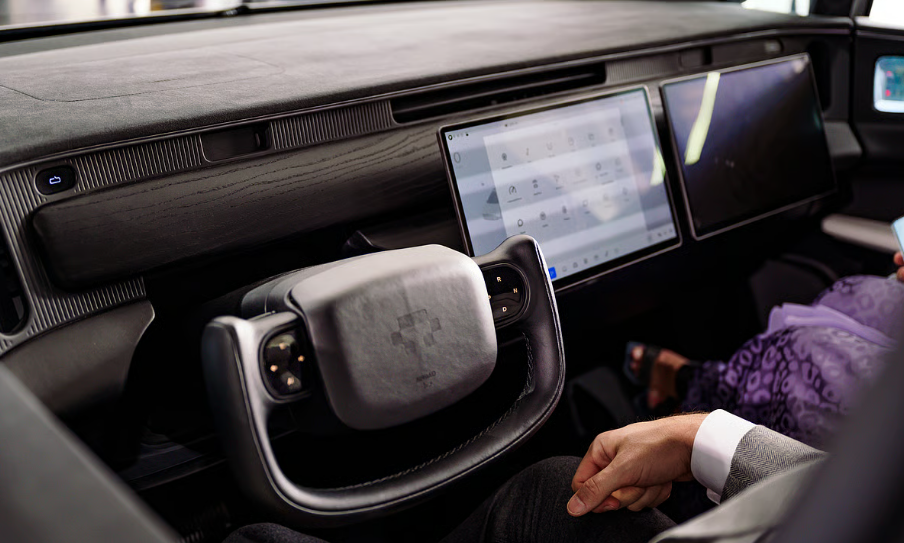
Inside, visitors were greeted with a spacious cabin styled to resemble a lounge rather than a traditional cockpit. Air suspension, a large central display, and retractable pedals contribute to what O’Dell described as a premium experience. The steering wheel folds away entirely at the touch of a button, allowing occupants to sit back once autonomous mode is engaged.
O’Dell maintained that the Tensor aims to set new safety standards on public roads, citing the vehicle’s ability to detect objects hundreds of metres ahead and its array of overlapping sensors. When operating in autonomous mode, the company will share responsibility with its insurance partners. “We stand behind the system,” he said.
For many visitors, stepping out of the vehicle required a moment to remember where the exit button was located — a small reminder of how unfamiliar this vision of the future still feels today.