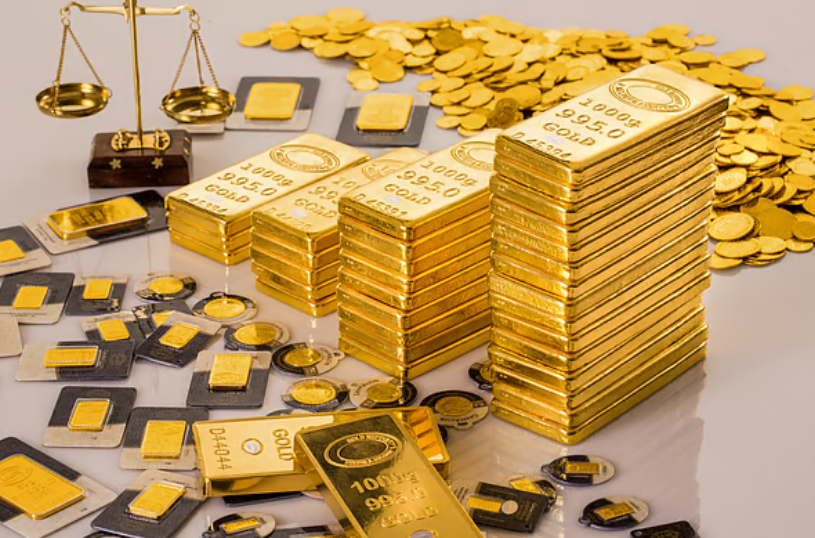
Gold trading turned turbulent last week, serving as a stark reminder that prices don’t move in a straight line, though the longer-term trend for the precious metal appears upward. After months of gains, gold prices fell more than 10 percent on Friday, marking the largest intraday drop since the early 1980s, according to Bloomberg News. The sell-off came shortly after prices approached $5,600 per ounce, surpassing targets set by many market forecasters.
“It was a dramatic reversal,” said Katie Stockton, technical strategist and founder of Fairlead Strategies. “It didn’t confirm any major sell signals, but it did trigger a short-term pullback. Our view is this is a pause rather than a prolonged correction.” Gold quickly regained some losses in the following days. The metal had risen 65 percent in 2025, recording its best annual gain in nearly fifty years.
Historically, gold has held value in uncertain times. Humans have prized it for millennia, crafting it into jewelry, using it as currency, and holding it as a safeguard against economic instability. In today’s world of rapid trading in stocks, bonds, and digital currencies, many investors still see gold as an unparalleled safe haven.
“The geopolitical risk climate is elevated compared to the last 10 to 20 years,” said Jim Steel, chief precious metals analyst at HSBC. “That, coupled with economic policy uncertainty, continues to support gold.” He noted that since Russia’s invasion of Ukraine in 2022, gold has become less likely to give back gains following geopolitical events, meaning future tensions could drive prices higher.
Other factors supporting gold include global policy uncertainty, trade concerns, a weaker dollar, high fiscal deficits, and central banks’ sustained buying. The recent decline coincided with President Donald Trump’s announcement of former Federal Reserve Governor Kevin Warsh as Jerome Powell’s successor. Analysts said Warsh’s perceived hawkish stance on inflation reduced uncertainty, prompting profit-taking and a temporary dip in prices.
Technical analysis also highlights key support levels. Stockton suggested that gold could find stability around the 50-day moving average, near $4,455 per ounce, while other levels at $3,924 and $3,775 could act as deeper support if the pullback continues.
Central bank purchases remain a key underpinning. More than 863 tonnes were bought last year, with expectations of similar demand this year, especially for large bars favored by institutional investors and high-net-worth buyers. Retail demand for jewelry and coins has softened, particularly in China and India, though major events like the Lunar New Year may temporarily boost physical demand.
Despite short-term volatility, strategists say gold’s fundamentals remain intact. JP Morgan’s Nikolaos Panigirtzoglou projected that a modest increase in private-sector allocation could push gold prices to $8,000–$8,500 per ounce over the coming years.
“The recent correction is flushing out weaker positions,” said Suki Cooper, Standard Chartered’s head of global commodities research. “Over the longer term, structural factors supporting gold remain strong, keeping the metal an attractive safe haven for investors.”