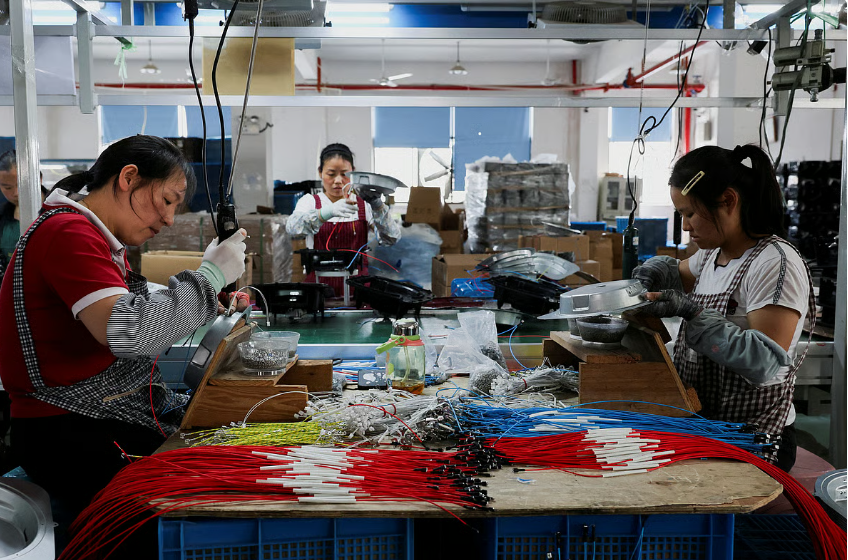
China’s manufacturing sector shrank for a sixth consecutive month in September, according to official data released Tuesday, underscoring the challenges facing the world’s second-largest economy as weak domestic demand and trade tensions with the United States weigh on growth.
The official manufacturing purchasing managers’ index (PMI), compiled by the National Bureau of Statistics (NBS), edged up to 49.8 in September from 49.4 in August, its highest reading in six months but still below the 50-point threshold that separates expansion from contraction. The figure exceeded analysts’ median forecast of 49.6 in a Reuters poll.
The persistent weakness highlights the dual pressures on China’s $19 trillion economy: a faltering post-pandemic recovery at home and the continued drag of U.S. tariffs on exports. “The rebound reflects a seasonal uptick as the summer disruptions are behind us and the government becomes more supportive,” said Xu Tianchen, senior economist at the Economist Intelligence Unit. He added that growth patterns this year have been uneven, with a strong first quarter, a slowdown in midyear, and expectations of a policy-driven rebound in the final quarter.
A private survey offered a brighter picture. The RatingDog General PMI, compiled by S&P Global, rose to 51.2 in September from 50.5, its fastest pace of expansion since March. The divergence reflects the difference in scope: the official survey focuses on larger, state-linked firms reliant on domestic sales, while the private index covers more export-oriented private companies.
Still, pressures remain evident. The NBS said the non-manufacturing PMI, which tracks services and construction, slipped to 50.0 from 50.3 in August, its weakest since November. The composite PMI, combining both sectors, inched up to 50.6. Employment levels, factory-gate prices, and new export orders all continued to contract, with export orders shrinking for the 17th month in a row.
Policymakers have introduced targeted measures in recent weeks, including consumer loan subsidies, but have stopped short of sweeping stimulus. Pan Gongsheng, governor of the People’s Bank of China, said last week that monetary tools remained available but resisted calls for an immediate rate cut. Economists at ING expect a 10-basis-point interest rate reduction and a 50-bp cut to banks’ reserve requirements by year-end.
Trade remains a crucial variable. China’s exports to India, Africa, and Southeast Asia have reached record highs, but the United States remains its most important market, accounting for around $400 billion in annual shipments. Analysts say uncertainty over U.S. policy is hampering business confidence, despite a recent phone call between President Xi Jinping and U.S. President Donald Trump that sought to ease tensions.
Zichun Huang, China economist at Capital Economics, cautioned that overcapacity and falling output prices suggest entrenched deflationary pressures. “We are sceptical that economic growth is on the cusp of a sustained rebound,” she said.
The latest figures will add urgency to next month’s Communist Party meeting, where leaders are expected to map out economic priorities for the next five years.