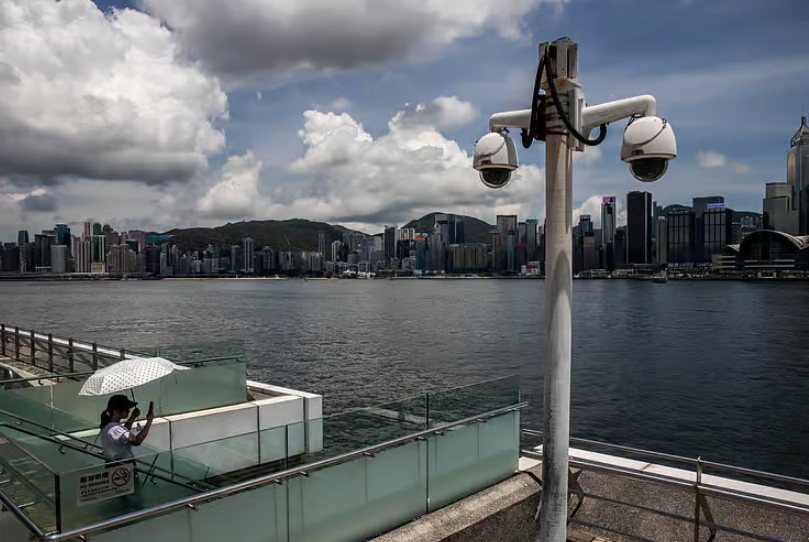
Hong Kong has introduced artificial intelligence-powered facial recognition and monitoring functions across its police camera network, expanding surveillance of public spaces as authorities seek to strengthen national security and prevent crime.
The new technology became operational on Monday as part of the police initiative known as SmartView. Police Commissioner Joe Chow said the system would improve existing surveillance capabilities and serve as a safeguard for law-abiding residents.
The rollout follows a major expansion of CCTV coverage since the programme began in 2024. Police have installed about 5,000 cameras across the city, which they credit with helping solve nearly 2,200 cases and leading to more than 2,800 arrests.
Authorities plan to increase the network to 60,000 cameras by 2028, according to documents submitted to Hong Kong’s legislature.
Security Secretary Chris Tang told lawmakers last year that the AI functions would be used to monitor crowds, read vehicle registration plates and help identify people, including suspects wanted by police.
The expansion comes as Beijing has tightened its control over Hong Kong following large pro-democracy demonstrations in 2019. China’s national security law, introduced in 2020, has significantly changed the city’s political environment, with critics arguing that it has restricted dissent and civil liberties.
The latest surveillance measures have prompted concerns among residents about privacy and the possible misuse of personal information.
A Hong Kong finance worker in his 40s, identified only by his surname Li because of safety concerns, told AFP that AI-powered monitoring could leave people with little control over their personal data.
“There are no secrets left anywhere,” he said, adding that many existing technologies had already collected people’s personal information and facial images.
Another resident, Saturday Zhou, said he was less concerned, noting that similar systems were already widely used in mainland Chinese cities. However, he stressed that authorities should be transparent about how information collected through the cameras was stored and used.
Chow acknowledged public concerns in comments to local media on Sunday, but said the system would not be abused.
Mainland China has deployed AI-assisted surveillance on a much larger scale, attracting criticism from international human rights organisations. A report by the Australian Strategic Policy Institute last year warned that the technology could help authorities automate censorship, expand monitoring and suppress dissent before it develops.
Similar facial recognition systems have also been adopted in other countries, including Britain. Critics have raised concerns about government access to sensitive personal information, inaccurate facial matches and the risk of wrongful arrests.
The European Union introduced restrictions in 2024 on real-time remote biometric identification in publicly accessible spaces for law enforcement, although limited exceptions are permitted.
Hong Kong’s expansion of AI surveillance is likely to intensify debate over how governments balance public security with privacy rights, data protection and oversight of law enforcement technology.