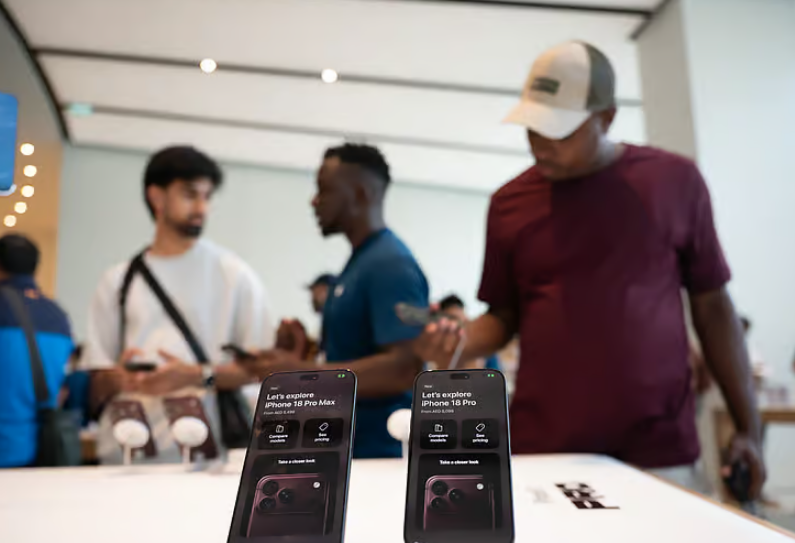
Smartphone prices are rising across major markets as manufacturers face a sharp increase in the cost of memory and storage components, breaking a long-standing trend of older devices becoming cheaper after new models arrive.
Apple’s iPhone 17, which launched in the UAE last year at Dh3,399, is now listed at Dh3,799 despite no change to the device itself. The price increase comes as manufacturers raise prices across both new and existing models.
Apple increased US prices for the iPhone 16, iPhone 17, iPhone Air and iPhone 17e by $100 following the launch of its iPhone 18 Pro range. In the UAE, the iPhone 17, iPhone Air and iPhone 17e each became Dh400 more expensive.
Other manufacturers have also raised prices. Samsung’s Galaxy Z Fold8 Ultra costs Dh400 more than the Galaxy Z Fold7, while Google has increased prices across its Pixel 11 range.
Google raised the price of the Pixel 11 Pro by $100 and reduced the memory in the standard Pixel 11 from 16GB to 12GB. The company attributed the changes to a severe shortage of RAM driven by suppliers.
Counterpoint Research estimates that prices of smartphones already on sale have risen about 15% globally this year and 18% across the Middle East and Africa. New models are launching at prices around 25% higher than their predecessors, while more than 40% of tracked devices have experienced price increases.
Memory costs are at the centre of the problem. Prices for DRAM and NAND have risen by more than 300% year on year, according to industry estimates, increasing the proportion of a phone’s production cost accounted for by memory.
Manufacturers are also facing competition for memory from the artificial intelligence industry. Chipmakers have shifted production capacity towards high-bandwidth memory, or HBM, which is used alongside AI processors in data centres. HBM requires more silicon, reducing the supply available for conventional smartphone memory.
The impact could continue for several years. SK Hynix has warned that memory demand may remain ahead of supply beyond 2030, while Intel chief executive Lip-Bu Tan has said significant relief may not arrive until 2028.
Increasing production capacity will take time. New memory plants can cost more than $15 billion and require at least 18 months to become operational. Planned facilities from Micron, Samsung and SK Hynix are expected to add capacity from 2027 onwards.
The pressure is particularly severe for budget smartphones, where memory accounts for a larger share of manufacturing costs. Some entry-level devices have already recorded price increases of more than 50% compared with last year.
The industry is also questioning whether prices will fall when memory costs eventually decline. During the memory downturn of 2022 and 2023, smartphone prices continued rising despite cheaper components.
For consumers, the changing market means replacing an older phone is becoming more expensive, particularly at the lower end. Buyers who need a new device may face higher costs for additional storage and memory as manufacturers continue to manage tight component supplies.