Saudi Arabia marked the beginning of the Hijri year 1448 AH with the annual replacement of the Holy Kaaba’s Kiswa, a centuries-old tradition that highlights the Kingdom’s commitment to caring for Islam’s holiest site and preserving its rich artistic heritage.
The new Kiswa was installed in a carefully coordinated operation at the Grand Mosque in Makkah. Produced entirely by Saudi craftsmen at the King Abdulaziz Complex for the Kaaba’s Kiswah, the sacred covering represents months of work combining traditional skills with modern manufacturing techniques.
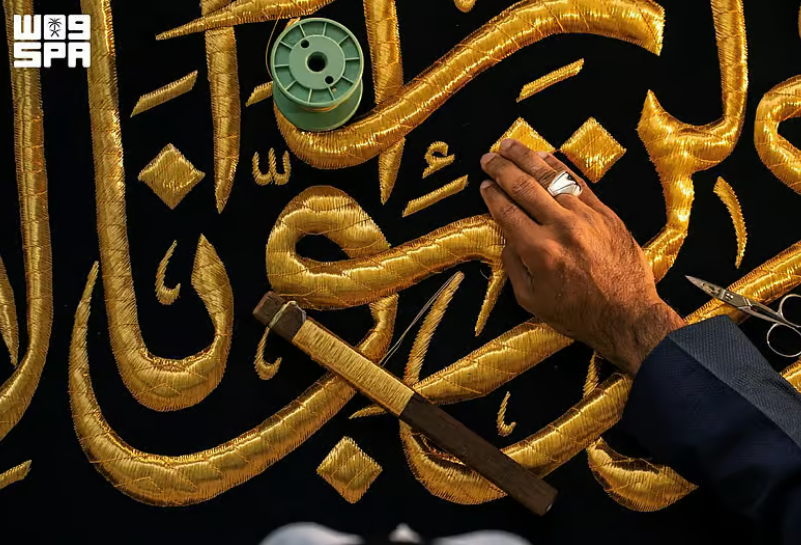
Around 150 Saudi artisans spent nearly 11 months creating the new Kiswa, which consists of 47 individually assembled panels of black silk. The covering is adorned with Quranic verses embroidered using silver threads plated with 24-karat gold. In total, 30 Quranic verses are featured across the Kiswa, which weighs approximately 1,410 kilograms.
The production process involved seven stages, beginning with water desalination and silk washing before moving through weaving, printing, embroidery, assembly and final inspection. Once completed, the Kiswa was transported to the Grand Mosque on a specially designed trailer to ensure it remained in perfect condition before installation.
Although it appears to be a single black cloth, the Kiswa is made from seven different types of fabric. The outer layer consists of black silk, while embroidered black silk carries decorative patterns and inscriptions. Additional layers of cotton provide strength and support, while red and green silk are used for decorative elements and specific sections associated with sacred spaces around the Kaaba.
The Kiswa also features intricate Islamic artistic designs. Among the most notable are the Samadiyat motifs, which combine geometric and floral patterns with verses from Surah Al-Ikhlas. Positioned at the corners of the Kaaba, these designs symbolize the Islamic belief in the oneness of God.
Another prominent feature is the Qanadil, or lantern motifs, located beneath the embroidered belt surrounding the Kaaba. These decorative elements contain Quranic inscriptions written in elegant Arabic calligraphy and serve as visual landmarks for pilgrims performing Tawaf.
The annual replacement ceremony also highlighted efforts to preserve traditional Islamic arts. The Royal Institute of Traditional Arts launched a digital campaign showcasing the craftsmanship involved in producing the Kiswa, including hand embroidery and the use of Thuluth calligraphy, one of the most respected forms of Arabic script.
The production of the Kiswa has evolved under successive Saudi rulers since the first dedicated workshop was established in Makkah in 1346 AH. Today, the King Abdulaziz Complex combines advanced technology with traditional techniques, ensuring the continuation of a heritage that has been passed down through generations while maintaining the highest standards of quality and craftsmanship.