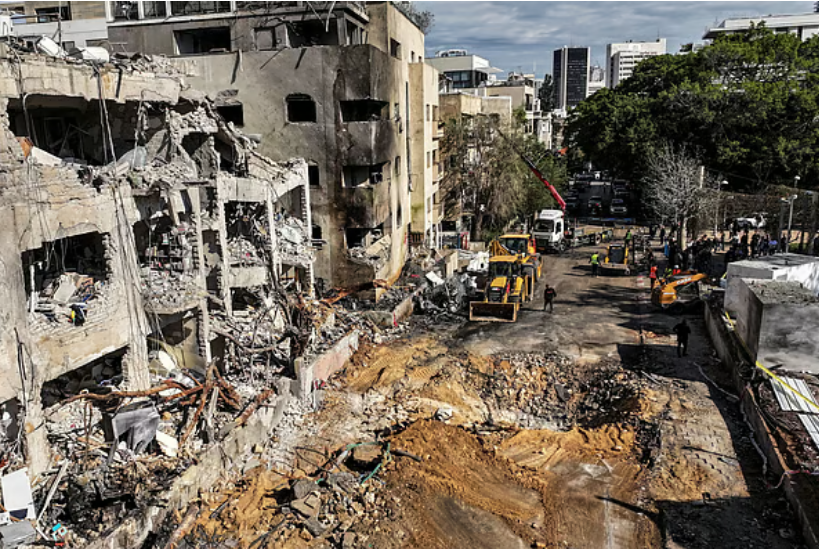
Iran’s Revolutionary Guards said Monday they had launched missile strikes on an Israeli government complex in Tel Aviv as well as security and military centres in Haifa and an attack on East Jerusalem. The announcement came as fighting between Iran, Israel and the United States continued to intensify following large-scale strikes over the weekend.
In a statement carried by state television, the Islamic Revolutionary Guard Corps (IRGC) described the operation as the tenth wave of attacks in its campaign against Israel. “Among the targets of this tenth wave were a targeted strike on the Zionist regime’s government complex in Tel Aviv, attacks on military and security centres in Haifa, and a strike on East Jerusalem,” the statement said.
The Guards said Kheibar ballistic missiles were used in the assault. Iranian officials did not immediately provide details on the extent of the damage or whether the strikes resulted in casualties. Israeli authorities had not issued a full assessment of the claimed impacts at the time of the announcement, though air raid sirens were reported in several areas.
The exchange follows what officials have described as unprecedented attacks by Israel and the United States on Iran on Saturday. Those strikes targeted key military and strategic sites inside Iran, marking one of the most direct confrontations between the long-time adversaries in recent history.
Since then, Iran has launched multiple waves of missile attacks aimed at Israeli territory and other targets in the region. Israeli defence systems have been activated repeatedly in response, with interceptions reported over major cities. Residents in Tel Aviv, Haifa and Jerusalem have sought shelter during alerts warning of incoming projectiles.
Haifa, a major port city in northern Israel, hosts important industrial facilities and security installations. Tel Aviv is home to government offices and military headquarters, making it a high-profile target. East Jerusalem holds political and religious significance and has often been at the centre of tensions in the wider conflict.
The use of Kheibar ballistic missiles signals Iran’s intent to deploy more advanced long-range capabilities, analysts said. The missile, named after a historic battle, is believed to have improved range and payload capacity compared with earlier systems.
The latest strikes underscore the rapid escalation of hostilities and raise concerns about a wider regional conflict. Governments across the Middle East and beyond have urged restraint, warning that continued exchanges could destabilise an already volatile region.
As both sides trade attacks, the situation remains fluid, with the risk of further retaliation high. Military and political leaders have signalled they are prepared for sustained confrontation, even as diplomatic channels remain uncertain.