Gulf countries have suffered an estimated $150 billion (Dh550.5 billion) in lost revenues and trade since the outbreak of the Middle East conflict, according to Majid Jafar, chief executive of Crescent Petroleum.
Speaking at a gathering of business, financial and government leaders in Washington, D.C., Jafar said the war has inflicted severe economic damage across the region, with destruction to energy infrastructure alone exceeding $60 billion. He added that Gulf economies are currently losing more than $1 billion in revenue and trade every day as the conflict continues.
Since fighting involving the United States, Israel and Iran escalated, energy facilities across the Gulf have come under attack, contributing to a surge in oil prices above $100 per barrel and creating uncertainty in global markets.
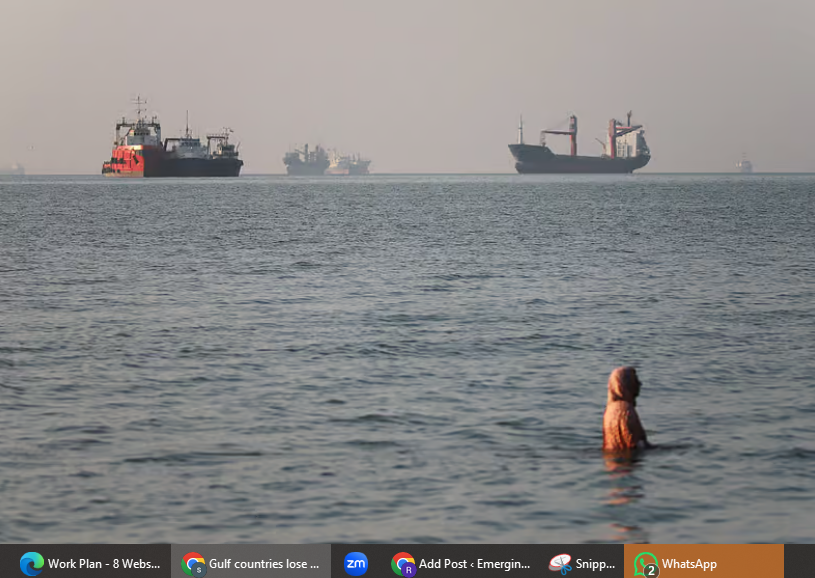
Jafar said the impact of the conflict extends far beyond the energy sector, describing it as a shock affecting entire economies. He pointed to the disruption of traffic through the Strait of Hormuz, one of the world’s most important shipping routes, as evidence of the risks posed by dependence on a small number of strategic trade corridors.
Around one-fifth of the world’s oil supply typically passes through the Strait of Hormuz. Iran’s blockade of the waterway during the conflict has disrupted global supply chains and affected countries far beyond the Middle East.
According to Jafar, the strait is also critical for the transport of commodities essential to modern economies. In addition to oil, it handles a significant share of global fertiliser shipments, helium supplies used in semiconductor production and industrial feedstocks relied upon by manufacturers worldwide.
He warned that the consequences of disruptions are being felt across multiple sectors, influencing food supplies, transportation networks and technology industries. The effects, he said, are reaching consumers and businesses around the globe, including populations in some of the world’s poorest countries.
Jafar paid tribute to workers in the energy industry who have continued operating facilities under difficult and dangerous conditions. He noted that engineers, technicians and field personnel have helped maintain supplies despite security threats and infrastructure damage.
He also condemned attacks on civilian energy facilities, arguing that such actions have consequences far beyond the countries directly involved in the conflict.
Looking ahead, Jafar said governments and companies must focus on building more resilient energy systems. He argued that years of prioritising efficiency have exposed vulnerabilities in global supply networks and that future investment should emphasize alternative export routes, storage capacity and cross-border infrastructure.
Across the Gulf, countries are already expanding pipeline networks, developing overland transport routes and increasing strategic storage facilities to reduce dependence on single chokepoints such as the Strait of Hormuz.
Jafar said nations that succeed in the next phase of the energy industry will be those that combine resource production with stronger and more resilient infrastructure, allowing them to better withstand future disruptions while creating long-term economic value.